



HomeElectronics NewsAccelerating Progress Toward Light-Speed Computing

Accelerating Progress Toward Light-Speed Computing

The breakthrough in computing is a leap toward light-speed processing, revolutionising data handling and pushing the boundaries of technology to new heights.
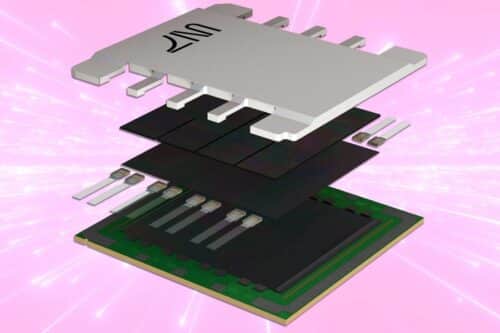
Lightmatter’s Passage chip interconnect takes advantage of light’s latency and bandwidth advantages to link processors in a manner similar to how fiber optic cables use light to send data over long distances. Sending information between chips is central to running the massive server farms that power cloud computing and run AI systems like ChatGPT.
Credits:Image: Courtesy of the researchers. Edited by MIT News
Lightmatter’s Passage chip interconnect takes advantage of light’s latency and bandwidth advantages to link processors in a manner similar to how fiber optic cables use light to send data over long distances. Sending information between chips is central to running the massive server farms that power cloud computing and run AI systems like ChatGPT.
Credits:Image: Courtesy of the researchers. Edited by MIT News

The shrinking of transistors, which enabled the era of ubiquitous computing, is reaching its limits, challenging the continuation of Moore’s Law and Dennard’s Scaling. This comes as the demand for computing power, driven by the rise of artificial intelligence, continues to grow.

- Advertisement -

Lightmatter, founded by three MIT alums, is advancing computing by reimagining the chip’s core. By using both light and electricity for data processing and transport, the company aims for more efficient operations. Its first products, an artificial intelligence chip and an interconnect for data transfer, utilise photons and electrons. Lightmatter is showcasing its technology with major tech companies, hoping to reduce the significant energy demand for data centres and AI models.

Lightmatter’s Envise chip integrates the strengths of electrons, such as memory, with the advantages of light, such as executing the extensive matrix multiplications required by deep-learning models.

Passage leverages light’s low latency and high bandwidth to connect processors, similar to how fibre optic cables transmit data over long distances. It also allows chips as large as wafers to function as a single processor, which is crucial for operating the large server farms that support cloud computing and AI systems like ChatGPT.

- Advertisement -

Both products aim to improve computing’s energy efficiency, which Harris believes is essential to meet increasing demand without significantly raising power consumption.

Lightmatter is collaborating with chipmakers and cloud service providers for widespread deployment. The team points out that existing semiconductor facilities can manufacture the company’s silicon-based equipment without significant process alterations.

The company’s bold plans aim to pave a new way for computing, with significant potential environmental and economic impacts.

“The two problems we are solving are ‘How do chips talk?’ and ‘How do you do these [AI] calculations?'” Lightmatter co-founder and CEO Nicholas Harris, PhD ’17, says. “Our first two products, Envise and Passage, address both questions.”

Nidhi Agarwal
Nidhi Agarwal
Nidhi Agarwal is a Senior Technology Journalist at Electronics For You, specialising in embedded systems, development boards, and IoT cloud solutions. With a Master’s degree in Signal Processing, she combines strong technical knowledge with hands-on industry experience to deliver clear, insightful, and application-focused content. Nidhi began her career in engineering roles, working as a Product Engineer at Makerdemy, where she gained practical exposure to IoT systems, development platforms, and real-world implementation challenges. She has also worked as an IoT intern and robotics developer, building a solid foundation in hardware-software integration and emerging technologies. Before transitioning fully into technology journalism, she spent several years in academia as an Assistant Professor and Lecturer, teaching electronics and related subjects. This background reflects in her writing, which is structured, easy to understand, and highly educational for both students and professionals. At Electronics For You, Nidhi covers a wide range of topics including embedded development, cloud-connected devices, and next-generation electronics platforms. Her work focuses on simplifying complex technologies while maintaining technical accuracy, helping engineers, developers, and learners stay updated in a rapidly evolving ecosystem.

SHARE YOUR THOUGHTS & COMMENTS

EFY Prime

Unique DIY Projects

Electronics News

Truly Innovative Electronics

Latest DIY Videos

Electronics Components

Electronics Jobs

Calculators For Electronics
