The solar charging reference design uses MPPT to improve energy use for outdoor applications like lighting and surveillance. Learn more!
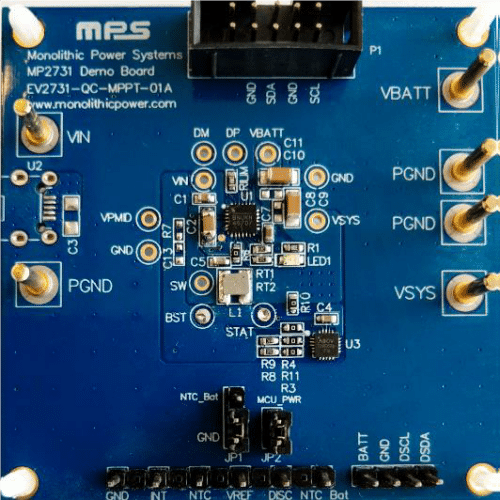
In the Internet of Things (IoT) era, increased connectivity has led to more outdoor devices relying on battery power and constant communication. Many of these devices now use solar panels for power.
This reference design focuses on maximum power point tracking (MPPT) for outdoor solar-powered systems.
It provides guidelines for creating a solar panel charger with a Lithium-ion battery and is suitable for outdoor solar surveillance cameras and lighting applications. MP2731 is a 1-cell solar maximum power point tracking (MPPT) charger reference design offered by Monolithic Power Systems.
This design suits outdoor solar surveillance cameras, lighting, and e-bike battery chargers.
The solar MPPT charger reference design provides design engineers with a comprehensive solution for integrating efficient solar charging into their products.
This design suits outdoor solar surveillance cameras, lighting, and e-bike battery chargers, offering small to medium-scale solar charging capabilities.
By leveraging the MP2731, a single-cell switching charger IC, and the MC96F1206, a low-cost 8051 microcontroller, engineers can minimize system size and cost while achieving high performance.
The design integrates key components, including a VIN connection switcher, an ADC, and a voltage/current sensing circuit, ensuring a streamlined design.
With a perturb-and-observe (P&O) algorithm for maximum power point tracking (MPPT), the design achieves at least 98% tracking accuracy, enabling optimal power output from solar panels even under varying irradiance conditions.
This reference design supports an operating input range of 3.7V to 16V, with a sustainable input voltage of up to 22V, a charge current of up to 4.5A, and a charge efficiency of up to 93% in a 9V input 5W system. It also includes NVDC power path management (PPM) for instant system-on functionality and battery supplementation.
Low power consumption is highlighted, with battery current as low as 41.5μA in standby mode and 13μA in shipping mode. Engineers can use the I2C interface for flexible configuration of system parameters and real-time status monitoring.
The design includes robust charging protections such as configurable JEITA profiles and safety timers for added reliability. Its compact core circuit area of 25mm x 25mm makes it suitable for space-constrained designs.
The system also provides clear guidelines for inductor selection, balancing cost, size, and efficiency to ensure optimal operation.
This reference design empowers engineers to maximize solar energy utilization in their projects. By incorporating the MP2731’s MPPT capabilities and leveraging the design’s flexibility, engineers can deliver efficient and reliable solar charging solutions tailored to various outdoor applications.
Monolithic Power Systems has tested this reference design. It comes with a bill of materials (BOM), schematics, assembly drawing, printed circuit board (PCB) layout, and more. The company’s website has additional data about the reference design. To read more about this reference design, click here.