The wearable tracks knee force and movement in real time. It helps monitor joint health, support recovery, prevent injuries, and connect with assistive devices.
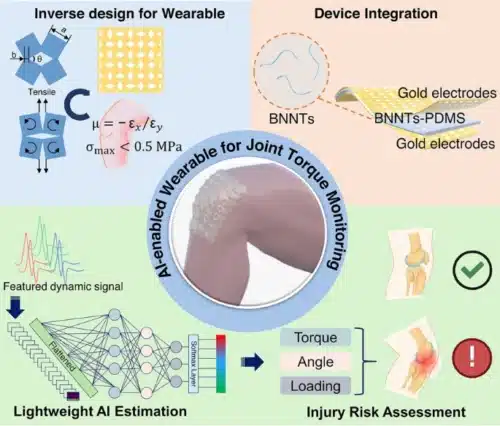
Researchers at the University of Oxford and University College London have developed a wearable sensor that tracks knee joint torque in real time using boron nitride nanotubes (BNNTs). Designed for use outside the lab, the device offers an alternative to joint monitoring systems.
This wearable is used for joint health monitoring. It can help detect problems early and track changes over time. It is used by people with joint conditions, older adults, and athletes. The real-time data supports rehabilitation and medical care.
It also supports injury prevention and recovery. By analyzing torque during movement, the device can alert users or clinicians to joint motions that may lead to strain or misalignment. In rehab, it helps ensure joint loads remain within limits and guides progress.
The device uses a material made from boron nitride nanotubes mixed with polydimethylsiloxane (PDMS) to detect knee motion. A built-in neural network processes signals directly on the device, estimating torque, angle, and load in real time.
Boron nitride nanotubes were chosen for their strength, heat resistance, and piezoelectric properties. When mixed into a PDMS base, they create a film that can detect knee motion.
The device also uses a structure with a negative Poisson’s ratio, made to follow knee movement. This helps it stay in place and improves motion tracking under loading.
A part of the system is a built-in neural network. It processes signals from the piezoelectric film in real time, converting them into data on torque, angle, and load. This allows the device to give feedback on joint conditions without external computers.
It is energy-efficient, made from low-cost materials, and works in different settings—suitable for both well-equipped and underserved areas.
The team plans to develop the device further by upgrading materials, adjusting the design, and improving the AI. They are also exploring integration with systems like wearable robots or exoskeletons for use in clinics, sports, and assistive tech.