




A reference board lets engineers capture clean heart signals by combining ECG, motion, and mechanical heart sensing in one patch.
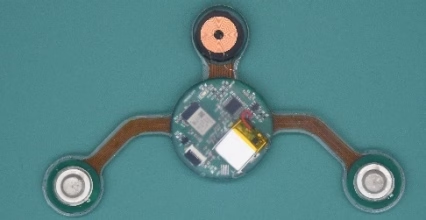
Wearable ECG systems often fail in real conditions because weak heart signals get distorted by motion and noise. The reference board from STMicroelectronics is designed to solve that problem. It combines ECG, seismocardiography SCG, gyrocardiography GCG, and motion sensing in a single electronic skin patch so engineers can capture heart data and correct it using real movement information.
The ECG signal is small. It is an AC signal with a bandwidth from 0.05 Hz to 100 Hz, and in some cases up to 1 kHz. Its amplitude is only a few millivolts, typically between 0.5 mV and 5 mV. Because the signal is weak, it is easily affected by noise. High frequency noise can come from motion artifacts, electromagnetic interference EMI, and electromyographic signals EMG. Low frequency noise can result from breathing, muscle contraction, and body movement. Common mode noise such as 50 or 60 Hz powerline interference and DC electrode offset also affects measurements.
Motion artifacts are a major challenge in wearable monitoring. These are unwanted electrical signals caused by user movement. Breathing can produce waveforms that resemble ECG signals. Walking, talking, coughing, or shifting position can distort the baseline. High frequency artifacts appear as sharp spikes from rapid motion. Low frequency artifacts appear as slow baseline drift from gradual movement or tremors. If not corrected, these artifacts can hide the real ECG waveform and affect heart rate, heart rate variability, anomaly detection, and classification.
The reference design addresses this by combining electrical and mechanical heart sensing. Along with ECG, it captures SCG and GCG signals. This allows engineers to compare electrical activity with mechanical heart motion. The system also includes motion sensing through an accelerometer and inertial measurement unit. Motion data can be used in correction or compensation algorithms. Engineers can apply filtering, adaptive filtering, and artifact removal techniques using real time movement data as a reference. Adaptive filtering adjusts parameters during operation to reduce motion impact.
The board supports heart rate and heart rate variability calculation. It can also be used for anomaly detection and classification. Developers can add routines for motion based events and context aware biosignal capture. This means ECG measurements can adapt depending on whether the user is resting, walking, or exercising.
Electrode integration is another practical issue in wearable design. The patch uses three snap connectors that support both standard wet ECG electrodes and dry electrodes. This allows engineers to evaluate signal quality, comfort, and long term wear performance. The board also supports a skin adhesive layer from DuPont Liveo, enabling realistic patch level integration during development.
For deployment, the system uses silicone rubber encapsulation and operates on a 35 mAh lithium ion polymer battery. Bluetooth connectivity enables wireless data transfer for home monitoring, activity tracking, athletic training, and telehealth. The system is based on a single lead ECG setup using two electrodes, which reduces size and complexity compared to a 12 lead configuration.
STMicroelectronics has tested this reference design. It comes with a bill of materials (BOM), schematics, assembly drawing, printed circuit board (PCB) layout, and more. The company’s website has additional data about the reference design. To read more about this reference design, click here.

