


A ready-to-use reference design that helps engineers quickly develop reliable, compact, and efficient isolated DC-DC power supplies with reduced design complexity and faster time-to-market.
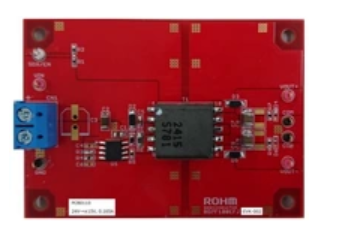
An important solution for design engineers working on isolated power supplies, particularly flyback DC-DC converters used in industrial and automotive electronics. Reference designs like this are highly valuable because they significantly reduce development time by providing validated circuit schematics, bill of materials (BOM), PCB layout data, and evaluation results. Engineers can directly reuse or adapt these designs instead of starting from scratch, ensuring faster prototyping, improved reliability, and reduced risk in power supply design. Such designs are especially useful in applications requiring electrical isolation, compact size, and efficient power conversion, including factory automation systems, communication equipment, and embedded control systems.
The REFFLBK002 design from ROHM Semiconductor focuses on implementing an isolated flyback DC-DC converter topology, which is widely used for step-down or voltage regulation while maintaining galvanic isolation between the input and output. This topology is preferred in many applications for its simplicity, cost-effectiveness, and ability to provide multiple outputs when required. The design integrates ROHM’s dedicated flyback converter IC with optimised external components to achieve stable operation, high efficiency, and a compact board footprint. By utilising an integrated controller, the design minimises component count and simplifies circuit implementation, which is beneficial for engineers aiming to reduce PCB complexity and improve manufacturability.
A key aspect of this reference design is its emphasis on safety and reliability. Isolation in flyback converters helps protect low-voltage circuits from high-voltage transients and noise, making the design suitable for harsh industrial environments. Additionally, the design incorporates essential protection features, including overcurrent protection, thermal management, and stable feedback control mechanisms. These features ensure that the power supply operates within safe limits under varying load and environmental conditions, which is critical for long-term system reliability.
Another important feature of the design is the availability of detailed design resources. These include schematic diagrams, PCB layout files, thermal evaluation data, and component selection guidelines. Such comprehensive documentation allows engineers to understand design trade-offs, optimise performance, and customise the circuit according to specific application requirements. The inclusion of evaluation boards further enables quick testing and validation, eliminating the need for initial hardware development and accelerating time-to-market.
In practical applications, this reference design can be used in a wide range of systems such as industrial control units, power modules for communication devices, and auxiliary power supplies in automotive electronics. Its ability to deliver regulated output voltage with isolation makes it particularly suitable for powering sensitive control circuits and microcontrollers. Overall, it serves as a reliable and efficient design template that helps engineers achieve robust power solutions while minimising design effort and development costs. For more information, click here.