Waste eucalyptus bark can be turned into carbon material that cleans water, filters air, and traps carbon dioxide using a process.
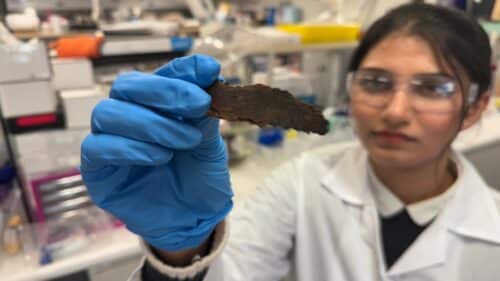
Researchers at Royal Melbourne Institute of Technology (RMIT) University in Melbourne have turned discarded eucalyptus tree bark into a porous carbon material that can purify water, filter air, and capture carbon dioxide, offering a practical way to convert forestry waste into a material for environmental cleanup.
The team developed a one-step activation process that transforms eucalyptus bark into highly porous carbon, creating a dense network of microscopic pores that trap pollutants and gases as water or air moves through it. The material could be used in water treatment, air filtration, industrial gas cleaning, and carbon capture systems.
Researchers found that the material’s effectiveness depends mainly on its pore structure rather than the bark itself. By adjusting that structure, they can improve how efficiently the carbon captures contaminants, making eucalyptus bark a practical and scalable raw material for a range of filtration applications.
The process also simplifies production. Compared with conventional methods for making porous carbon, the one-step approach reduces extra processing, energy use, and infrastructure requirements, which could make large-scale production easier and less expensive.
Eucalyptus bark is typically treated as low-value waste, but the study shows it can be repurposed into a functional material with strong adsorption performance. This adds value to an underused forestry by-product while supporting circular economy principles by reusing existing biomass.
The approach could be particularly useful in Australia, where more than 900 species of eucalypt and related trees provide a steady source of bark from existing forestry operations without competing with food production.
Further testing is needed to assess durability, regeneration, and large-scale performance before commercial use. Researchers also plan to study which eucalyptus species produce the most effective porous carbon and explore collaboration with Indigenous communities on species selection.