




Flexcompute and Northrop Grumman have developed an AI-driven physics simulation platform that cuts spacecraft docking preparation timelines from months to seconds, accelerating advanced space missions and aerospace engineering workflows.
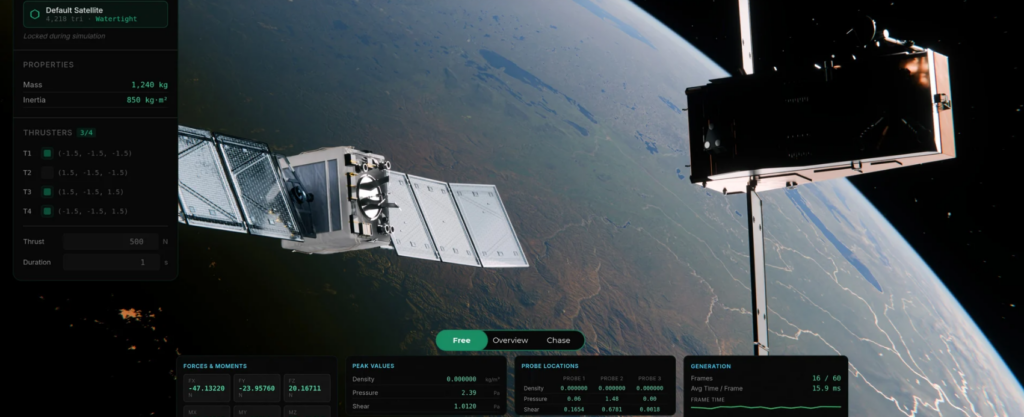
Flexcompute and Northrop Grumman have developed an AI-based physics simulation infrastructure that could significantly reduce the time needed to prepare spacecraft for docking and orbital manoeuvres. The system, built using NVIDIA’s PhysicsNeMo framework, automates the complex simulation workflows used to predict thruster plume interactions during space operations.
In conventional aerospace workflows, modelling thruster impingement—the interaction between rocket exhaust plumes and nearby spacecraft surfaces—requires months of high-fidelity simulations and massive datasets. These simulations are critical for docking, station-keeping, rendezvous missions, and space robotics, where even small errors can affect spacecraft stability, fuel consumption, or thermal performance.
The newly developed AI Physics model reduces this process dramatically by generating accurate predictions in real time while also providing uncertainty estimation for mission-critical decision-making. According to the companies, the platform can reduce mission preparation timelines by up to 100 times compared to traditional simulation approaches.
The infrastructure combines GPU-native simulation with physics-informed AI models trained using customised architectures and physics-aware constraints. The companies said the system can replace millions of conventional simulations with AI-driven predictive models capable of producing results within seconds. NVIDIA’s accelerated computing platform and open-source PhysicsNeMo framework form the foundation of the solution.
Beyond faster mission preparation, the technology could also improve spacecraft efficiency. More accurate plume interaction modelling allows engineers to reduce structural safety margins, optimise fuel use, and extend mission lifetimes. The development also highlights the growing adoption of AI-assisted physics simulation across aerospace and electronics-intensive industries, where complex engineering validation cycles remain a bottleneck.
