




Researchers have developed an AI training method that enables robots to transfer skills learned in simulation into real-world tasks more efficiently, reducing dependence on costly physical training data.
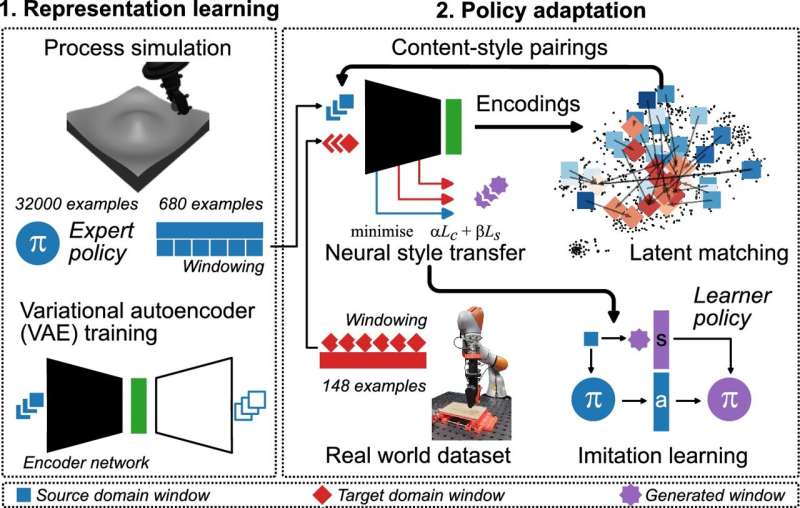
Researchers at Aston University have developed a new AI-based training framework that allows robots to transfer skills learned in laboratory simulations into real-world environments with significantly higher reliability. The approach could accelerate deployment of robots in manufacturing, warehouses, laboratories, and industrial automation systems where physical training is expensive, slow, and sometimes unsafe.
Traditionally, robots are trained using large-scale simulation environments before being deployed physically. While simulations allow rapid learning, robots often struggle when moving into real-world environments because physical conditions differ from virtual models. Variations in lighting, object textures, friction, force, and unpredictable interactions create what researchers call the “simulation-to-reality gap.”
The newly developed AI method addresses this problem by improving how robots generalise learned behaviours across different environments. Instead of relying heavily on massive real-world datasets, the framework teaches robots to adapt simulated experiences into real operational conditions. This reduces the need for repeated physical retraining and lowers deployment costs.
According to the researchers, the system is particularly useful for tasks involving physical interaction, such as cutting, gripping, manipulation, and handling objects. Collecting real-world training data for such operations is often difficult because it can damage hardware, consume materials, or introduce safety risks. The AI-based approach enables robots to acquire many of these capabilities safely in virtual environments before fine-tuning them for practical deployment.
The work reflects a broader trend in robotics and AI research toward transferable learning systems. Similar efforts across the industry are focused on enabling robots to learn tasks once and reuse those skills across multiple platforms and environments rather than retraining from scratch for every application.
Researchers believe such adaptive AI models could become critical for future electronics manufacturing and industrial automation, where robots must increasingly handle flexible production lines, small-batch manufacturing, and dynamic operating conditions. Faster deployment cycles and reduced training overhead could also improve scalability for collaborative robots and autonomous systems used in logistics, semiconductor production, and advanced assembly operations.

