

New four-channel automotive ReDriver improves 32Gbps signal integrity for AI-driven cockpit platforms, supporting PCIe 5.0, SAS4, and CXL while reducing jitter, power consumption, and PCB design complexity.
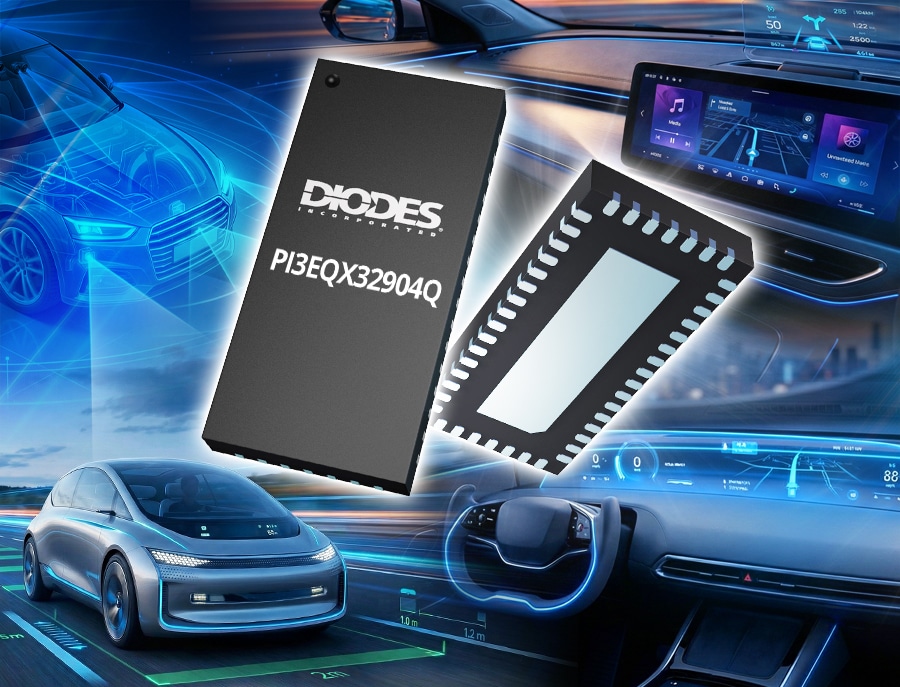
A new automotive-grade four-channel linear ReDriver by Diode Incorporated has been launched to address growing signal-integrity challenges in next-generation smart cockpit platforms integrating ADAS, infotainment, and digital instrument clusters into unified computing architectures.
Built for high-speed GPU+CPU system-on-chip (SoC) platforms, the device supports data rates up to 32Gbps and is optimised for emerging automotive interfaces based on PCI Express (PCIe) 5.0, SAS4, and Compute Express Link (CXL). The launch reflects increasing demand for robust signal conditioning in AI-driven automotive computing systems, where higher bandwidth and longer PCB trace lengths can introduce jitter and intersymbol interference.
The main features are:
- Supports 32Gbps high-speed data transmission
- Four independent differential signal channels
- Optimised for PCIe 5.0, SAS4, and CXL
- Ultra-low jitter using the SiGe BiCMOS process
- Less than 5mW power in deep standby mode
The ReDriver uses a 0.13µm silicon germanium (SiGe) BiCMOS process to improve linearity and maintain ultra-low jitter during high-speed data transmission. With four independent differential channels, the device can operate across different coding styles and data rates without disrupting link training or protocol setup, making it suitable for evolving automotive interface standards.
To simplify system optimisation, the device integrates programmable linear equalisation, flat-gain control, and output-linearity adjustment via an I2C interface. This allows designers to tune signal performance for different board layouts and media types without extensive firmware overhead. The capability to extend PCB trace lengths could also help lower system cost and reduce power consumption by minimising the need for additional signal-conditioning components.
The ReDriver also supports Modern Standby (S0 Low Power Idle) operation, consuming less than 5 mW in deep standby while maintaining rapid wake-up capability. This feature targets automotive platforms that require always-on readiness with minimal energy consumption.
Operating from a 3.3V supply, the device supports an industrial automotive temperature range of -40°C to +85°C. The component is offered in a compact W-QFN package for high-density automotive electronics designs.
Click here for the original announcement.