





A distributed phased-array ground station architecture that could triple satellite data throughput while reducing infrastructure cost and easing deployment for next-generation LEO networks.
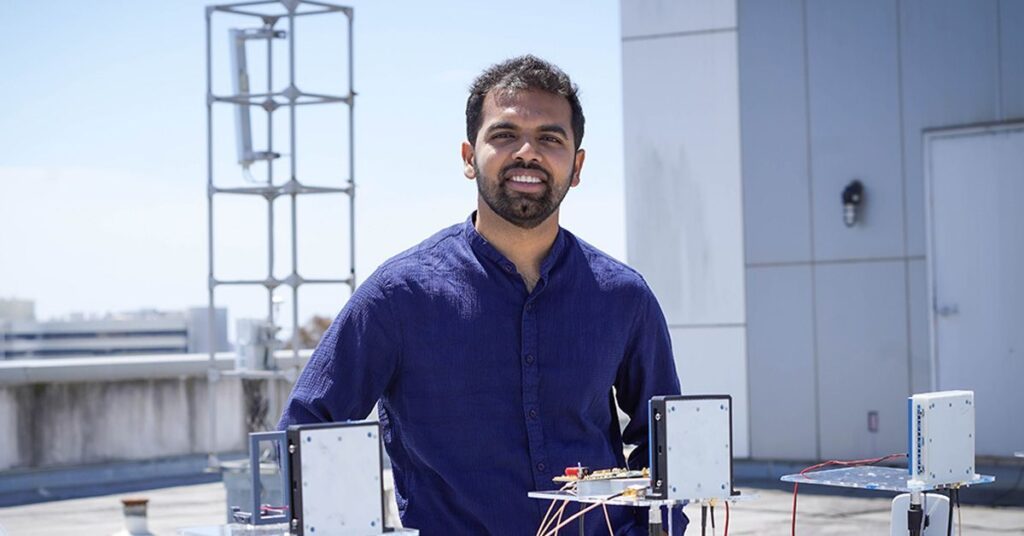
As low Earth orbit satellite constellations rapidly expand, researchers at the University of California San Diego have identified a growing bottleneck—not in space, but on the ground. Their newly developed system, called ArrayLink, replaces conventional large parabolic satellite dishes with multiple compact flat-panel antenna arrays distributed across rooftops and existing telecom infrastructure.
The architecture is designed to support the surge in broadband, IoT, Earth observation, and satellite-to-mobile connectivity services being launched by operators such as SpaceX and Amazon. According to the research team, current ground stations struggle to scale because traditional mechanically steered dishes can track only one satellite at a time and lose valuable connection time during repositioning.
ArrayLink instead uses multiple commercially available phased-array panels that electronically steer beams without moving parts. Researchers found that spreading 16 antenna panels across nearly a kilometre enables near-field MIMO behaviour, allowing up to four simultaneous data streams between satellite and ground station. This approach reportedly delivers as much as three times higher throughput compared to conventional dish-based systems.
The system is also designed to lower deployment costs. Rather than building dedicated ground-station sites, the antenna arrays could potentially be mounted on existing 5G towers and connected through already leased telecom infrastructure. Researchers say the design relies on off-the-shelf hardware, reducing both complexity and capital expenditure.
The project was led by researchers from the UC San Diego Jacobs School of Engineering and Qualcomm Institute. Experimental testing reportedly showed close agreement between theoretical modelling and real-world performance measurements. .


