A Gender-Responsive Public Health Intervention Rooted in Community Ownership.
An Interview with DEVIKA RAJ BATRA Founder & Lead, Project Amrit. Interview by Nidhi Agarwal, Senior Technology Journalist, EFY Group.

Founder & Lead, Project Amrit
Project Amrit stands for far more than safe water technology. It is a gender-responsive public health intervention rooted in community ownership — and in less than three years, it has become one of the most distinctive examples in India of what it looks like when a young person engineers not just a device, but a structural shift.
While its core technology — a Compact Submersible UV-C LED Sterilisation Unit — addresses microbial contamination in stored household drinking water, the deeper problem it tackles is structural. Within underserved urban communities, unsafe water is a daily risk managed largely by women and girls, who are expected to collect, store, and protect household water despite having the least control over the infrastructure and sanitation conditions that determine its safety. The labour is invisible. The accountability is theirs. The technology built for them, until now, did not exist.
Devika Raj Batra, a Class 12 student from New Delhi, decided to change that.
Through field research in Kusumpur Pahari — one of Delhi’s largest informal settlements — she designed Project Amrit to reduce this invisible burden by pairing decentralised water disinfection with a grassroots implementation model led by Amrit Ambassadors, a community network that drives education, trust-building, and sustained adoption from inside the settlement itself. As a result, the project advances not only safer drinking water but also health security, gender equity, and community resilience. It positions clean water as a shared social right, rather than a private household struggle.
Project Amrit has drawn recognition from the British Science Association, the Government of NCT of Delhi, and nominated for India’s Pradhan Mantri Bal Puruskar 2025. In this interview, Devika speaks about the science, the engineering, the community model and the deeply personal recognition that drove her to build a device specifically for the bucket, the matka, and the drum. The vessels in which India’s safe-water crisis quietly continues, long after the tap has been built and almost always, in the hands of a woman.
Q. What inspired you to start Project Amrit?
A. Project Amrit began not in a laboratory, but in the lanes of Kusumpur Pahari — one of Delhi’s largest urban slums, where over fifty thousand people live within an area smaller than most middle-class apartment complexes. I had gone there expecting to study the water-supply problem. What I found was something quite different.
I watched a young girl, perhaps eleven years old, ladle drinking water from a plastic drum in the corner of her one-room home. The drum sat on the floor. The lid was missing. Her hand entered the water as she drew it out. That single moment reframed the problem for me. The water she was drinking had not been contaminated at the tap — it had been contaminated at home, in the only vessel her family had to store it.
But there was a second realisation, and it has shaped Project Amrit just as much as the first. In every home I visited, the person responsible for that water — for collecting it, for storing it, for protecting it, for deciding when it was clean enough to drink — was a woman or a girl. Mothers carrying buckets up narrow stairs in the dark before sunrise. Daughters scrubbing matkas before school. Grandmothers boiling water on kerosene stoves to ration what little fuel they had. The labour of household water safety in India has a gender, and it has had one for a very long time. The infrastructure that fails it does not.
| “The labour of household water safety in India has a gender, and it has had one for a very long time. The infrastructure that fails it does not.” |
That is when I understood what Project Amrit had to be. Not a water-purification project that happened to benefit women — but a gender-responsive public-health intervention rooted in community ownership. Within underserved urban communities, unsafe water is a daily risk managed almost entirely by women and girls, who are expected to collect, store, and protect household water despite having the least control over the infrastructure that determines its safety. Project Amrit was designed to reduce that invisible burden — and to do so by working with the community, not for it.
Q. How does the UV-C purification in your device work, and what is the principle behind it?
A. UV-C disinfection works at the level of microbial DNA. Wavelengths in the 260–280 nanometre range — the germicidal band — are absorbed almost perfectly by the genetic material of bacteria, viruses, and protozoa. The absorbed energy creates thymine dimers, which are essentially molecular knots in the DNA strand. A microorganism with knotted DNA cannot replicate, and a microorganism that cannot replicate cannot infect. This is how UV-C achieves disinfection without introducing a single chemical into the water.
I chose UV-C over the alternatives deliberately. Boiling demands fuel and time, both of which slum households ration carefully — and both of which the women of those households pay for in labour before anyone else does. Chlorination requires precise dosing, leaves behind a chemical residue and an unpleasant taste, and depends on supply chains that frequently break down at the last mile. Conventional UV mercury lamps work, but they contain mercury — a serious hazard if a lamp shatters in a domestic vessel — and they consume more power than is reasonable in a setting with intermittent electricity.
UV-C LEDs solve all three problems at once. They contain no mercury, switch on instantly with no warm-up cycle, draw very low power, and have an operating life measured in tens of thousands of hours. They are also small enough to be packaged into a submersible housing that fits inside the vessels people already own. That last point is what makes the technology decentralised. It does not depend on a centralised treatment plant working correctly, on a piped supply being maintained, or on a chemical supply chain holding up. It works in the home, with the people who use it.
I am also honest about what UV-C cannot do. It does not remove heavy metals, it does not reduce turbidity, and it does not work on heavily silted water. Project Amrit is therefore designed for the specific contamination problem it can solve well — biological recontamination of stored water — and is paired with simple sediment-management practices we teach during deployment.
Q. What design challenges did you face while developing the device, and how did you overcome them?
A. The challenges were not academic; they emerged from the field, and they shaped every engineering choice. Five stand out.
The first was form factor. Every textbook UV-C purifier is built around a pipe — water flows through a chamber and is irradiated as it passes. But a slum household does not have plumbed inlets. It has buckets, matkas, drums, and steel handis. So I inverted the architecture. Instead of taking water to the device, I built the device to be taken to the water. The result is a sealed, submersible unit that disinfects in-place inside whatever vessel the family already uses.
The second challenge was power. Grid electricity in Kusumpur Pahari is intermittent, and load-shedding is routine. I designed the device to accept a standard 5V USB input — the same input every mobile phone uses — so that any household charger or small solar panel can run it. There is no proprietary cable.
The third was UV-C safety. UV-C light is harmful to human skin and eyes. I built a submersion-detect interlock into the unit so the LEDs activate only when the device is fully submerged in water, with the housing acting as a physical shield. The light cannot accidentally fire in open air.
The fourth was usability — and this is where the gendered reality of who actually uses the device shaped the engineering most directly. The primary user, in almost every household we deploy in, is a woman. Many have limited literacy, because the infrastructure of formal education in slum communities continues to fail girls and women first. Many are operating the device at the end of a long working day, in low light, often with a child on their hip. So I built it for her. One button. One switch. No instruction manual required, no reading involved, no second hand needed. Anyone can operate the device — but it was designed with a specific user in mind, and she was the most overlooked one in the household.
The fifth was durability. Slums are humid, dusty, and exposed to monsoon flooding. The housing is sealed, the electronics are conformally coated, and the moving parts are kept to a minimum long-life LEDs, no consumables, no filter cartridges to replace.
| “Anyone can operate the device — but it was designed with a specific user in mind, and she was the most overlooked one in the household.” |
Q. Where was your product manufactured, and how did you manage the manufacturing process?
A. Project Amrit’s earliest prototypes were built by hand. I assembled them myself — sourcing UV-C LEDs from verified industrial suppliers, designing the housing through iterative 3D-printed shells, and benchmarking each version against the previous one. Every iteration was driven by what we learned in Kusumpur Pahari, not by what looked elegant on a CAD screen.
The second phase has been a structured transition from prototype to manufacture-ready design. And I do not take that lightly. It places a responsibility on the project to deliver something that holds up at scale, not only in pilot.
Q. How did you design the charging system so that it works with a standard mobile charger?
A. The charging architecture is built around a simple but deliberate constraint: every household in our target community already owns a mobile-phone charger. Most own two or three. If the device requires a proprietary power brick, we have built a barrier to adoption before the device is even taken out of the box.
So the input is 5V USB — the universal standard. From there, the internal circuitry takes over. A small DC-DC converter steps the voltage to the level the UV-C LEDs require, while a constant-current driver holds the current steady at the LEDs’ rated specification. Holding current steady is critical for UV-C, because the disinfection dose delivered to the water depends directly on the LED’s optical output, which depends on the drive current. A wobbly current means a wobbly dose, which means inconsistent disinfection. Constant-current driving makes the device’s performance predictable across power sources of varying quality.
Q. How did you test and validate your product’s effectiveness and accuracy?
A. Validation happened across two layers, because a water-treatment device has to satisfy both the science and the people whose health depends on it.
The scientific layer was microbiological. Water samples were drawn from household storage vessels in Kusumpur Pahari before treatment, treated using the device, and then re-sampled. The samples were tested for coliform bacteria and E. coli — the standard indicators of faecal contamination — and the resulting log-reduction values confirmed disinfection performance consistent with international UV-C benchmarks for the dose delivered. We calibrated the cycle time to ensure sufficient UV exposure across the full vessel volume, accounting for water clarity in our target environment.
The field layer was epidemiological in spirit. We documented health-outcome improvements among many residents through paired water-safety and hygiene awareness sessions and post-deployment follow-ups. Reductions in waterborne illness episodes within deployed households were tracked through community feedback and the Amrit Ambassadors network.
Those numbers matter. But what sits behind them matters more — and it is the part that rarely makes it into the data tables. Waterborne illness in slum households does not affect everyone equally. It affects women, who absorb the caregiving burden whenever a child falls sick — losing wages, losing rest, losing the small windows of personal time they fight for. And it affects girls, for whom diarrhoeal illness is one of the leading reasons they miss school in India. So when we say “300 residents experienced documented health improvements,” what we are really saying is that 300 women and girls got time, attendance, and dignity back. The validation is microbiological; the meaning is gendered. The intervention advances not only safer drinking water, but health security, gender equity, and community resilience — and the data exists to begin showing it.
Q. As a school-going student, how did you balance your studies with working on innovative projects?
A. Honestly, the balance came from realising that the two were not in competition.
School gave me the discipline. Project Amrit gave the schoolwork its meaning. When you have spent a Saturday in Kusumpur Pahari watching a mother boil water on a kerosene stove because her daughter is unwell, your physics and biology classes stop being abstract. They start to feel urgent. I studied harder, not less, because the project demanded that I understand the science properly — not at the level of a school answer, but at the level of something that has to actually work in someone’s home.
I am also aware that I am a young woman building something for other women — and that this carries its own weight. There were moments in Kusumpur Pahari when a mother would look at me and ask, gently but seriously, “You came here to fix our water?” — and I had to be ready not just with the science but with the seriousness the question deserved. Being a girl in a STEM and social-innovation space in India still means proving yourself twice — first that you understand the problem, and then that you have the right to be solving it. I did not want to be celebrated as a young woman doing innovation. I wanted the innovation to be useful, and I wanted the women it was built for to recognise that it was built by someone who took their lives seriously.
Practically, I structured my time tightly. Weekdays were for school and for design work in the evenings. Weekends and school holidays were for fieldwork, prototype testing, and Ambassador meetings. I learned to say no to social commitments that did not matter. My parents and teachers became part of the support system — my school understood what I was building and gave me the flexibility to attend community events when needed; my family came with me on field visits when it would have been unsafe to go alone.
There is also something I want to be honest about: I had access to the support that made this possible — encouragement, transport, mentors, time. Many girls in India have the ideas but not the support, and the gap is structural, not personal. If anyone reading this is in that position, I would say: start small, document everything, and be willing to ask.
| “School gave me the discipline. Project Amrit gave the schoolwork its meaning.” |
Q. What awards and recognitions have you received as a young innovator?
A. Project Amrit has been recognised across science, government, industry, and investment, which is unusual for a single early-stage project, and I am grateful for each of them.
The Gold CREST Award from the British Science Association is the recognition I am most proud of scientifically — it is their highest tier for student-led research, and it required independent review of the methodology and findings.
I have been nominated for the Pradhan Mantri Rashtriya Bal Puraskar 2025 in the Science and Innovation category — one of India’s highest civilian honours for young people — by Member of Parliament Ms. Bansuri Swaraj.
Q. How did you introduce your innovation to communities and users, and what was their response?
A. This was, in many ways, the hardest part of the entire project — and the part I am most committed to.
I knew from the beginning that even the best-engineered device fails if the community does not trust it. Slum residents are not unfamiliar with outside actors arriving with solutions, taking photographs, and disappearing — and a young student arriving with what looked like a torch and asking them to dip it into their drinking water was, fairly, met with scepticism. The scepticism was sharpest from the women, and rightly so: they have been the recipients of well-intentioned interventions that did not understand their lives for far too long.
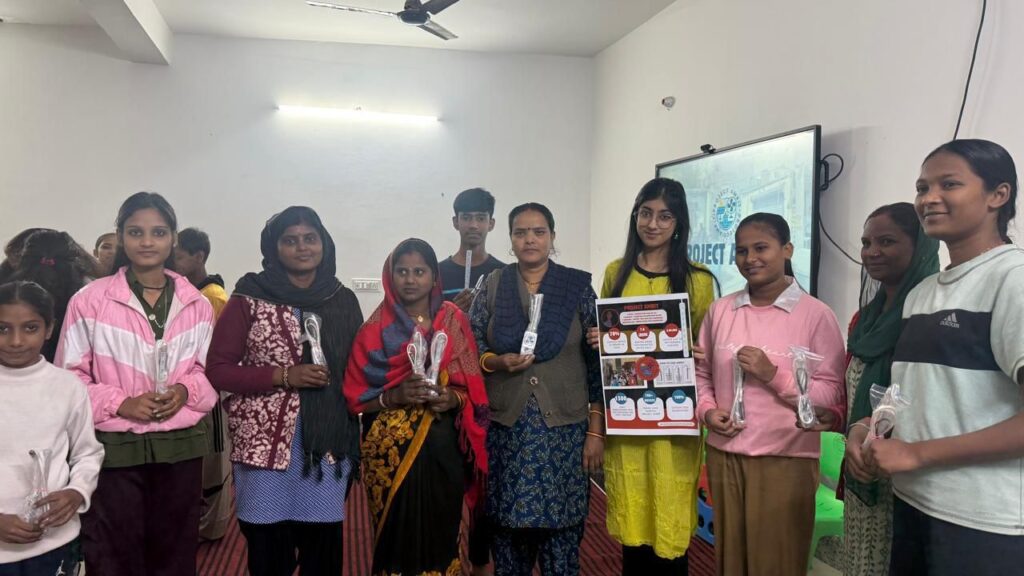
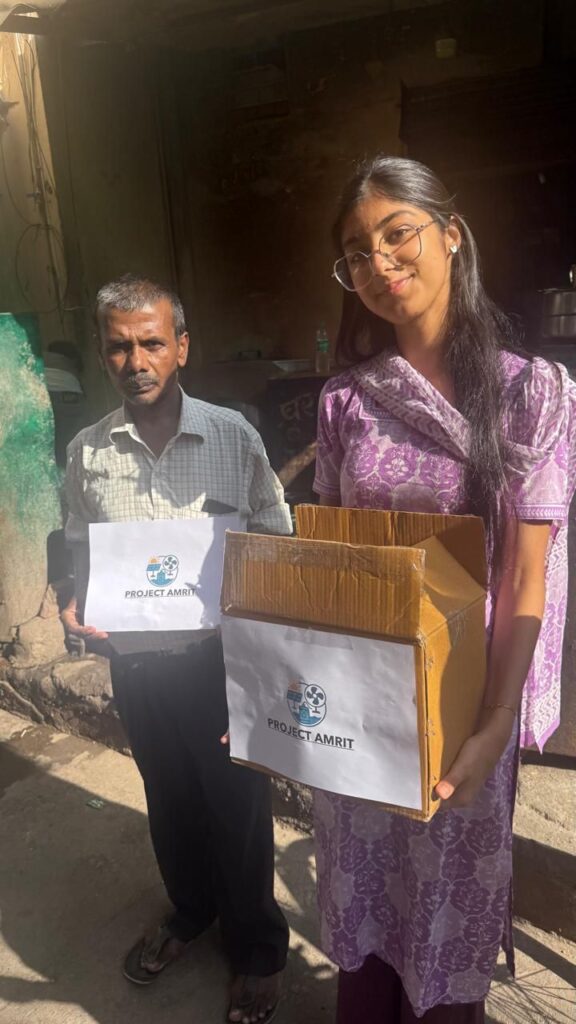
So I built the Amrit Ambassadors model — a peer-led, community-rooted adoption layer that sits between the technology and the user. We recruited and trained 70 youth volunteers from within Kusumpur Pahari itself, with a deliberate effort to bring young women into the network. They were not outsiders explaining science; they were neighbours, sisters, daughters. They demonstrated the device in their own homes first. They answered questions in the local idiom. They handled feedback, logged maintenance issues, and built the trust no external campaign could have built.
What we are building, structurally, is not just a device-distribution programme. It is a grassroots implementation model — decentralised water disinfection paired with peer-led education, trust-building, and sustained adoption from inside the community itself. The technology is the entry point; the community ownership is the intervention. That distinction matters, because the failure mode of public-health innovations in low-income settings is almost never the device. It is almost always the assumption that a working device, by itself, will be enough.
The response unfolded in stages. Curiosity came first. Cautious adoption followed. And then came the shift I had been hoping for but could not have engineered — the women in the community began asking for the device by name. The same women who had been carrying the invisible weight of household water safety for years became the project’s most active advocates.
| “The same women who had been carrying the invisible weight of household water safety became the project’s most active advocates.” |
There is a specific memory I carry from this phase. A woman in her late forties, mother to four children — two of whom had been hospitalised in the preceding year for waterborne illness — pulled me aside after one of our Ambassador sessions and said, in Hindi, that for the first time, someone had built something for the work she did. I am not sure I will ever receive a more meaningful acknowledgement in my life. The technology was important. But what mattered more was that the women of Kusumpur Pahari — for the first time — were being recognised as the experts on their own water, not as the passive recipients of someone else’s solution.
By the most recent count, Project Amrit has reached 700+ households and over 5,000 residents in Kusumpur Pahari, with health-outcome improvements documented across 300+ residents. Local maintenance systems are now embedded into the community itself, which means the project continues to grow whether or not I am physically present. We are expecting to reach 10,000 individuals by July. That last number matters less to me than the structural shift behind it: clean drinking water has moved from being a private struggle that fell on women, to a shared community responsibility led by women themselves. That is the change Project Amrit was built to create.
Q. Are you planning to commercialise your product in the near future?
A. Yes — but with a clear philosophy about what “commercialisation” should mean for a product like this.
Project Amrit is not a profit-maximising consumer product. It is a social-impact product that needs sustainable unit economics so it can scale without depending on grant cycles. If we price it like a consumer device, we exclude the people we built it for. If we depend entirely on donations, we plateau the moment funding does. The route forward has to be a hybrid one.
we are building toward three distribution channels in parallel: NGO and CSR-led procurement at scale; government partnerships, where state water and health departments can deploy the device through existing community health-worker networks — the vast majority of whom are women, and who already hold the trust that the technology needs to land; and direct community-led distribution through the Amrit Ambassadors model, where micro-financed adoption keeps the device affordable at the household level.
What I want Project Amrit to advance, in the end, is not just safer drinking water. It is health security, gender equity, and community resilience. And at the level of how the world thinks about clean water in low-income settings, it is the reframing of clean water itself — from a private struggle borne by the women of one home, to a shared social right held collectively by the community. That reframing is the real intervention. The device is what makes it tangible.
| “Clean water is not a private household struggle. It is a shared social right.” |
Looking further out, the design choices we made — submersible form factor, USB-power compatibility, chemical-free operation, low maintenance — are not Delhi-specific. They are slum-specific. The same problem exists in informal settlements across South Asia, Sub-Saharan Africa, and parts of Southeast Asia, and so does the gendered structure of who carries it. My ambition is to take what we have learned in Kusumpur Pahari and replicate it where it is needed — not as a Western export, but as a model engineered in a slum, for slums, by people who understand them.
We started with one settlement in Delhi. We are on track to reach ten thousand individuals within six months. I would like the next number, in a few years, to have an extra zero in it. And when I say I want that number larger, I am not really talking about devices. I am talking about the women — across India and beyond — who have been holding this responsibility alone for generations. Every device that goes into a home is, for me, a small return of time, of health, of education, of agency to the woman who runs that home. Scaling Project Amrit is not a manufacturing target. It is a measurement of how many women stop carrying this weight alone.
| “Scaling Project Amrit is not a manufacturing target. It is a measurement of how many women stop carrying this weight alone.” |
| ABOUT PROJECT AMRIT Project Amrit stands for far more than safe water technology. It is a gender-responsive public health intervention rooted in community ownership. While its core technology, the Compact Submersible UV-C LED Sterilisation Unit — addresses microbial contamination in stored household drinking water, the deeper problem it tackles is structural. Within underserved urban communities, unsafe water is a daily risk managed largely by women and girls, who are expected to collect, store, and protect household water despite having the least control over the infrastructure and sanitation conditions that determine its safety. Project Amrit was designed to reduce this invisible burden by pairing decentralized water disinfection with a grassroots implementation model led by Amrit Ambassadors — a community network of 70 trained youth volunteers, with deliberate inclusion of young women, who drive education, trust-building, and sustained adoption. As a result, the project advances not only safer drinking water, but also health security, gender equity, and community resilience. It positions clean water as a shared social right, rather than a private household struggle. Recognised by the British Science Association (Gold CREST), nominated for the Pradhan Mantri Rashtriya Bal Puraskar 2025 Project Amrit is on track to reach more than 10,000+ individuals by July 2026. Its founder, Devika Raj Batra, is a Class 12 student in New Delhi. |