




LED technology enters vehicle production, reduces components and power use, and changes how lighting systems are built in electric cars.
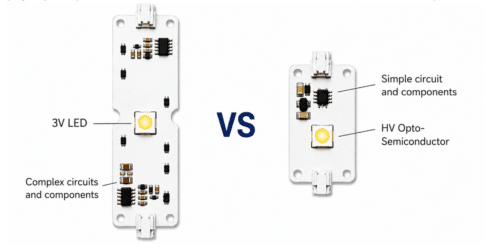
Seoul Semiconductor Co., Ltd. (KOSDAQ: 046890) has announced the mass production rollout of its High Voltage (HV) opto-semiconductor technology, marking a step toward higher-efficiency lighting systems for hybrid and electric vehicles. The company said the technology is already being adopted by four major automotive brands across the Americas, Europe, and Asia, with plans to expand to 10 vehicle models by the end of this year.
The HV opto-semiconductor system replaces conventional 3V LED architectures with a 12V single-chip design paired with high-voltage driver technology. This shift reduces the number of driver-related components in EV and hybrid vehicle lighting systems by more than 10% and lowers power consumption by around 10%, according to the company. Seoul Semiconductor says this results in simpler electrical system design, reduced cost, and improved overall efficiency.
At the core of the technology is a multi-junction P-N structure integrated into a single chip. In conventional electric vehicle architectures, where battery systems often operate at around 300V, standard 3V LEDs require significant voltage step-down conversion—typically around a 1/100 ratio. The company’s HV design reduces this conversion requirement to roughly 1/10 in higher-voltage implementations, helping to cut conversion losses.
The company also highlighted that traditional lighting architectures often require multiple conversion stages and supporting components to manage voltage differences. This adds complexity, increases heat generation, and raises system cost. By contrast, the HV opto-semiconductor approach reduces the need for separate components, simplifies PCB design, and improves thermal performance and durability. The company claims a reduction of up to 20% in driver cost compared with conventional LED systems.
Matthew Fras, COO of North America Sales at Seoul Semiconductor, stated: “With global EV sales — including hybrids — set to surpass 20 million units this year, that number is expected to double to 40 million units in five years. As vehicles become more functionally advanced, the value of opto-semiconductors per vehicle is also projected to grow from $100 to $200, meaning the overall opto-semiconductor market will expand fourfold. We aim to significantly expand our market share through our ‘HV Opto-Semiconductor’ technology, with a goal of breaking into the global top 10 automotive brands by year-end, and we plan to elevate the automotive division to become the largest business unit within the Seoul Group this year.”

