





A 3D printed passive panel enhances multi dimensional wireless signals, improving coverage and capacity for future 6G communication environments.
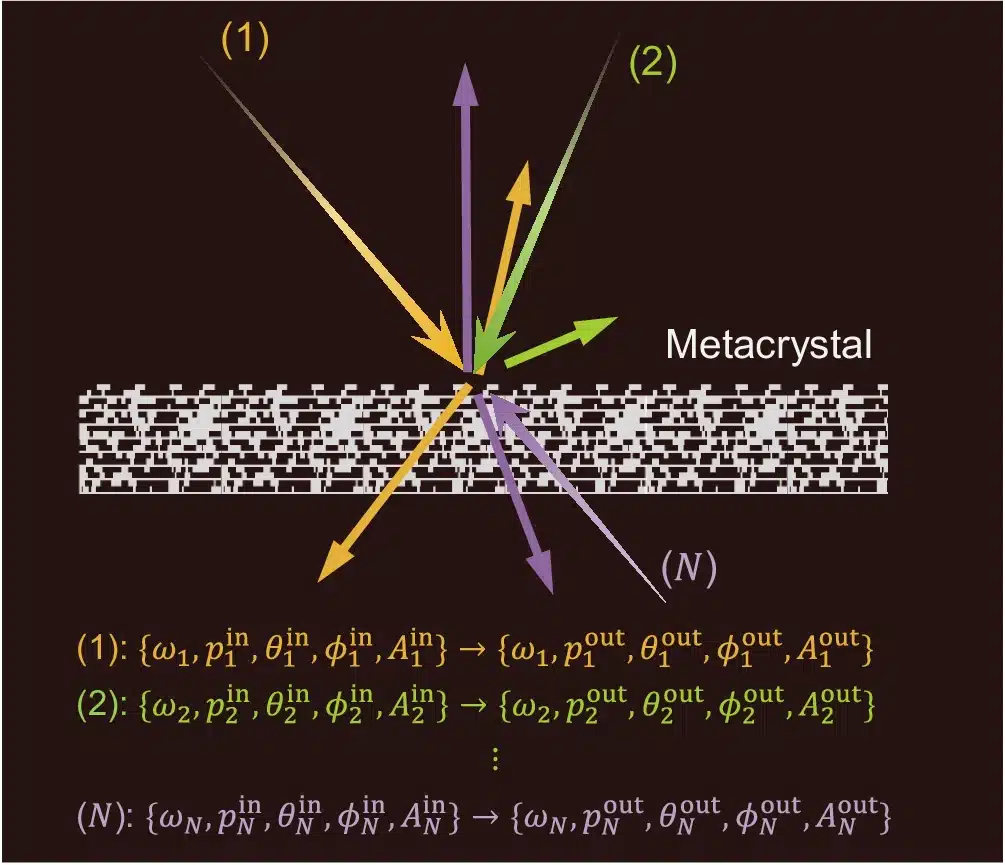
Researchers from Stanford University and Aalto University have demonstrated a new passive wireless surface architecture that can handle multiple signal channels simultaneously across different frequencies, angles and polarizations. The 3D printed structure, called a metacrystal, operates without any active electronics, tuning components or external power supply.
The work was carried out by teams from Aalto University’s Department of Electronics and Nanoengineering in collaboration with Stanford’s Ginzton Laboratory. The system is designed to improve wireless communication performance in complex environments where signals often degrade due to obstruction, interference and multi-path effects.
Unlike conventional reconfigurable intelligent surfaces that rely on flat layouts and electronic control systems, the metacrystal uses physical depth and internal geometry to manipulate electromagnetic waves. The structure is fabricated from patterned plastic and air gaps and is designed through topology optimization, allowing it to encode multiple signal responses within a single passive object.
In testing, the system demonstrated significant improvements in signal strength and channel capacity. In non line of sight conditions, received signal strength increased by 20 to 24 decibels, while channel capacity improvements reached up to 139 percent compared to environments without the panel. The architecture is capable of simultaneously handling multiple signal functions across different frequencies and polarizations.
The researchers also reported that the system can route, reflect and absorb signals in parallel using a single integrated design. Simulated results showed near perfect efficiency under ideal conditions, while experimental prototypes delivered strong performance improvements despite fabrication limitations and small scale testing.
The metacrystal concept suggests a shift in how future 6G environments could be designed. Instead of relying on complex active hardware, fixed passive structures embedded into walls or ceilings could enhance wireless performance in predefined environments such as factories, transit hubs and indoor networks.
The study highlights growing interest in low cost, scalable approaches to wireless infrastructure, where physical design replaces electronic control in shaping signal behavior for next generation communication systems.

