What if one chip could handle both driving assistance and in-car functions? A new vehicle platform aims to reduce hardware costs and simplify system design.
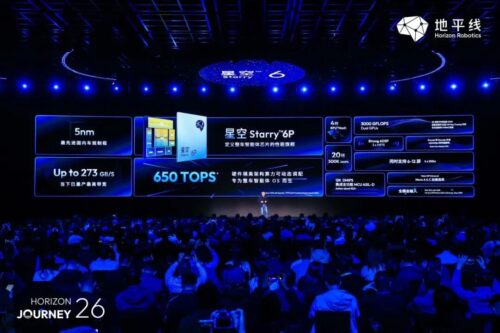
Horizon Robotics has launched Horizon Starry, described as China’s first intelligent vehicle chip that combines cockpit and driver-assistance functions on a single chip. The new platform is designed for intelligent vehicle Agentic operating systems and enables both cockpit and intelligent driving systems to run from one computing platform.
The launch marks a shift away from the traditional approach of using separate chips for different vehicle functions. The company claims that the Starry platform enables integrated deployment of intelligent cockpit features and advanced driver-assistance systems, reducing hardware complexity while improving coordination between vehicle functions.
Known as “Starry 6,” the platform is intended to replace the conventional dual-chip architecture used for intelligent driving and cockpit systems. By consolidating these functions into a single chip, it aims to reduce hardware costs and simplify vehicle development. The platform provides a central computing architecture with low-latency communication and high bandwidth, allowing simultaneous deployment of cockpit AI agents and intelligent assisted-driving models.
To ensure safety, the chip incorporates a security architecture that keeps intelligent driving and cockpit functions isolated while allowing them to operate efficiently on the same platform.
The flagship Starry 6P version is manufactured using a 5nm automotive-grade process. It integrates a high-performance CPU delivering 500K DMIPS, a GPU capable of 3,000 GFLOPS, a BPU offering 650 TOPS of AI computing performance, and three HiFi 5 audio DSPs. The platform supports up to 128GB of LPDDR5X memory with bandwidth reaching 273GB/s and is capable of running large AI models directly at the edge.
According to Horizon Robotics, the Starry platform could help automakers reduce hardware costs by approximately RMB 1,500 to RMB 4,000 per vehicle while providing a scalable architecture for future intelligent vehicle functions and personalised user experiences.
Click here for the original announcement.