

Researchers at the University of Adelaide have demonstrated a bio-inspired swarm robotics system that could improve mining efficiency while reducing travel distance and energy consumption.
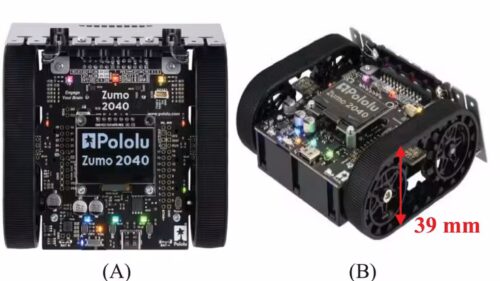
Researchers at the University of Adelaide have demonstrated a bio-inspired swarm robotics system that could improve the efficiency of future mining operations. Using the Pololu Zumo 2040 robotics platform, the team showed how groups of small autonomous robots can work together to retrieve ore more efficiently while reducing travel distance and energy consumption.
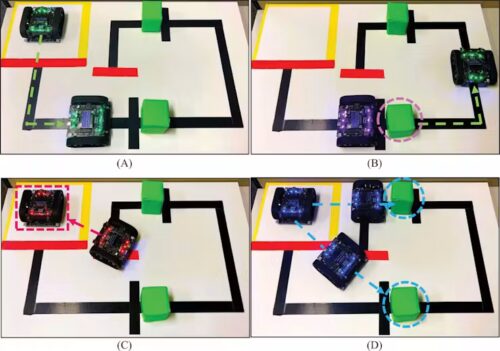
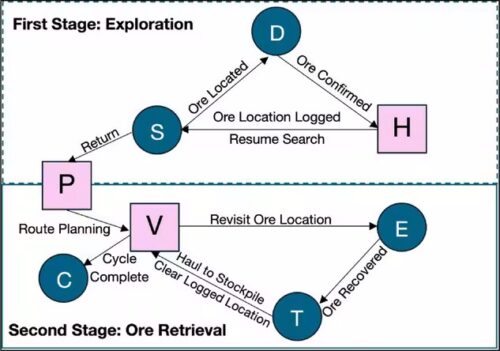
The study compared three ore collection strategies. The first used a single robot to repeatedly search for and transport ore. The second, inspired by ants, divided the task between two robots, allowing one to locate ore while the other carried it to the collection point. The third adopted a honeybee-inspired approach, in which robots first mapped all ore locations before collecting them in an optimised sequence.
During a 16-metre experiment involving eight ore blocks, the honeybee-inspired strategy delivered the best performance. It reduced total travel distance by up to 80%, lowered estimated energy consumption by around 50%, and completed ore retrieval approximately 60% faster than the conventional single-robot approach.
The researchers designed the control algorithms to mimic the cooperative behaviour of social insects. By enabling robots to share tasks and optimise their routes instead of working independently, the system reduced unnecessary movement and improved the overall efficiency of ore collection.
The prototype robots were built around the Raspberry Pi RP2040-powered Pololu Zumo 2040 platform and incorporated wheel encoders, line-following sensors, proximity sensors, an OLED display and finite-state control algorithms for autonomous navigation and coordination.
Although the experiments were conducted on a laboratory testbed rather than in an operational mine, the researchers believe the results provide practical validation of swarm robotics for resource extraction. They say the approach could support more efficient, scalable and resilient mining operations once validated through larger-scale field trials.