


Could a redesigned copper cooling plate dramatically lower data center energy use while handling rising chip heat more efficiently than existing methods?
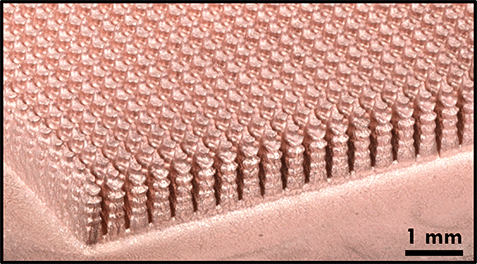
Researchers at the University of Illinois have developed a 3D printed pure copper cold plate that could significantly reduce the energy required to cool data centers. The technology combines computational design with advanced additive manufacturing to improve heat removal from high performance processors.

The approach could lower cooling energy consumption from about 550 megawatts to 11 megawatts for every gigawatt of computing power, reducing cooling to just 1.1 percent of a data center’s total energy use.
The development addresses a growing challenge as processors become more power dense and traditional air cooling struggles to keep pace. Lower cooling energy can reduce operating costs while helping data centers manage increasing computational demands without proportionally increasing electricity consumption. The researchers also suggest the design approach could be adapted for cooling other electronic systems and industrial applications.
The team designed the cold plate fins using topology optimization, a mathematical technique that evaluates numerous geometries to maximize heat transfer while minimizing the energy needed to circulate coolant. The resulting fin structures feature intricate pointed and jagged shapes that cannot be produced using conventional manufacturing methods.
To fabricate the design, the researchers used electrochemical additive manufacturing, a process that deposits pure copper layer by layer through electrochemical plating. Unlike commonly used aluminum alloys or stainless steel, pure copper offers much higher thermal conductivity. The manufacturing process also enables feature sizes between 30 and 50 micrometres.
Performance testing showed the optimized cold plates delivered up to 32 percent better cooling than conventional rectangular fin designs while reducing pressure drop by as much as 68 percent at the same cooling level, lowering the energy needed to pump coolant through the system. “By bridging the gap between computational design and manufacturing capability, our approach provides a pathway for more energy efficient liquid cooling of chips and other electronics,” says Behnood Bazmi, Graduate Student at the University of Illinois.