A capacitor design increases capacitance and reduces resistance, helping reduce component count in 48-V power systems.
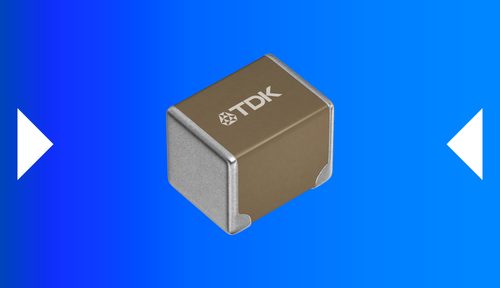
TDK Corporation has expanded its CN series of low-resistance soft-termination surface-mount device (SMD) multilayer ceramic capacitors (MLCCs) with a new 100-V, X7R-rated component that offers 10 μF capacitance in a 3225 package measuring 3.2 × 2.5 × 2.5 mm. TDK says this is the industry-leading rated capacitance for a component of this size. Mass production is scheduled to begin in September 2026.
The new MLCC is designed for smoothing and decoupling power lines in 48-V systems used in artificial intelligence (AI) servers, humanoid robots, electrified vehicles (xEVs), and industrial equipment. The CN series uses TDK’s proprietary terminal structure to provide soft termination while maintaining low resistance comparable to standard terminal MLCCs.
The use of 48-V power systems is increasing in these applications as they can reduce power loss and the weight of wiring harnesses. This has increased the need for 100-V MLCCs with higher capacitance. At the same time, soft-termination MLCCs are being used to improve reliability by reducing the risk of cracks caused by external mechanical stress. However, the resin layer used in conventional soft-termination designs can increase equivalent series resistance (ESR).
TDK has addressed this issue by optimising the resin electrode structure, material selection, and product design. The new CN series components offer twice the capacitance of TDK’s conventional MLCCs of the same size while significantly reducing ESR.
The higher capacitance can reduce the number of MLCCs required on a board. This can lower component count and mounting area, helping manufacturers reduce the size of equipment while improving reliability in 48-V power lines.
The CN series also uses resin electrodes and supports high voltage and large capacitance to improve application reliability. For automotive applications, the components have been qualified according to the AEC-Q200 reliability standard.
The company plans to expand the CN series further to address different requirements across AI servers, robotics, automotive systems, and industrial equipment.
Click here for the original announcement.