




Researchers develop a color-changing tactile sensor that converts pressure into visible patterns, enabling robots to perceive touch instantly using inexpensive cameras and minimal computation.
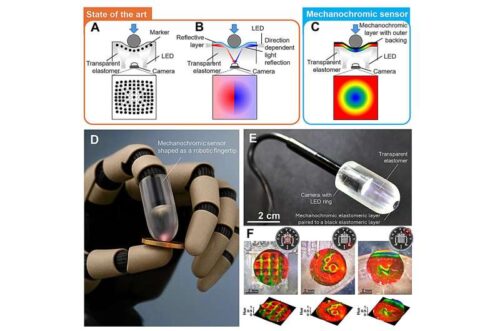
Researchers at Queen Mary University of London have developed a novel color-changing tactile sensor that enables robots to “see” touch in real time by converting mechanical pressure directly into visible color patterns. The innovation eliminates the need for complex computational processing typically required by conventional vision-based tactile sensing systems.
The sensor is based on a mechanochemical material that transforms invisible forces into dynamic structural colors. When pressure is applied, the material generates detailed color maps representing contact, strain and pressure. These patterns can be captured instantly using a standard low-cost USB camera, allowing robots to interpret touch without relying on sophisticated reconstruction algorithms or dense arrays of embedded electronic sensors.
Published in the journal Science Advances, the research demonstrates a new approach in which sensing is integrated directly into the material itself rather than through complex microelectronics. This significantly simplifies sensor design while maintaining high spatial resolution and real-time performance.
The technology offers broad applications across manufacturing and healthcare. In industrial settings, robotic grippers could precisely assemble delicate microscale components by monitoring subtle pressure variations during handling. In medicine, advanced prosthetic limbs could provide users with richer tactile feedback, while robotic surgical systems may be able to distinguish healthy and abnormal tissue by analyzing pressure signatures generated during contact.
The research team also demonstrated that the sensor can capture highly detailed surface features, including fingerprint ridges, highlighting its exceptional sensitivity. According to the researchers, the approach overcomes a long-standing trade-off in tactile sensing, where achieving high resolution traditionally required heavy computational processing that introduced delays.
By directly encoding mechanical interactions into optical signals, the new sensor provides a fast, scalable and cost-effective solution for robotic touch sensing. The breakthrough could accelerate the development of more dexterous robots capable of safely interacting with fragile objects and operating more effectively alongside humans in industrial, medical and service environments.

