




New PXI and PXIe analogue output modules expand hardware-in-the-loop testing with high-channel-density signal generation, sensor simulation and thermocouple emulation for embedded systems.
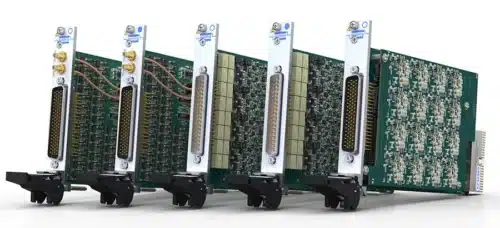
Pickering Interfaces has expanded its signal sourcing and sensor simulation portfolio with a new range of PXI and PXIe analogue output modules designed to simplify hardware-in-the-loop (HIL) testing, sensor simulation and functional verification. The modules combine high channel density, flexible signal generation and precision analogue outputs, enabling engineers to create more realistic test environments for embedded controllers, production systems and electronic devices.
The new range includes digital-to-analogue converter (DAC) modules, multi-channel waveform generators and thermocouple simulation modules. Together, they support applications including HIL simulation, production testing, fault injection, sensor emulation and validation of embedded devices under test (DUTs).
The DAC modules provide up to four fully isolated analogue output channels within a single 3U PXI or PXIe slot. Each channel can be independently programmed across multiple voltage and current ranges, delivering outputs of up to 40 V and 20 mA. They can also simulate open-circuit conditions, allowing engineers to reproduce wiring faults and sensor failures during testing.
The waveform generator modules offer up to 32 independent output channels per slot and support waveform generation from DC to 300 kHz. Each channel includes dedicated memory for sine, standard and arbitrary waveforms, while software-controlled Direct Digital Synthesis enables precise frequency adjustment. Trigger functions also allow synchronised waveform generation and frequency sweeps.
The thermocouple simulator modules provide precise microvolt-level sensor simulation with built-in fault insertion. They feature up to 32 fully isolated channels, support multiple thermocouple types and cold-junction configurations, and handle common-mode voltages to replicate real sensor behaviour without external switching hardware.
Compatible with both Windows and Linux, the modules include APIs for C, Python, C#, MATLAB, Simulink and LabVIEW, allowing straightforward integration into existing automated test environments. The expanded portfolio is intended to help engineers perform more comprehensive validation while reducing testing complexity and system development time.
Click here for original announcement.
