





Researchers have created an oxide-based electronic device that combines processing and memory in one chip, paving the way for faster, low-power neuromorphic computing systems.
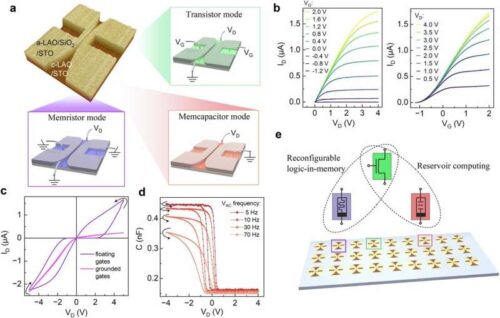
Researchers from the Federal University of São Carlos (UFSCar) in Brazil, working with international collaborators, have developed an oxide-based electronic device that combines data processing and memory within a single chip element, marking a significant step toward more efficient neuromorphic computing. The proof-of-concept device integrates multiple electronic functions into one component, mimicking key features of the human brain while potentially reducing energy consumption and simplifying future AI hardware.
Unlike conventional computers, where processing and memory are physically separated, the new device performs both tasks together. It operates as a transistor while also functioning as a memristor and memcapacitor, allowing it to process, store and retain information simultaneously. This multifunctional behaviour is achieved through an interface between two oxide materials, where a conductive electron layer can be precisely controlled.
A key innovation is the use of side control gates that gradually accumulate electrical charge to regulate the conductive channel. Instead of relying on oxygen vacancy movement, as many memory devices do, the chip stores information through controlled charge localisation. This enables analogue operation with multiple intermediate states rather than simple on-off switching, making the device better suited for brain-inspired computing.
Researchers also demonstrated the chip’s ability to perform neuromorphic tasks, including reservoir computing, simple pattern recognition and reconfigurable logic operations. The device exhibited synaptic plasticity, strengthening responses after repeated stimuli in a way that resembles biological learning. Simulations showed energy consumption of only a few nanojoules per operation, highlighting its potential for low-power AI applications.
Although the technology remains at the proof-of-concept stage, researchers believe integrating processing, memory and adaptive logic into a single component could overcome major bottlenecks in today’s computing architectures. Future work will focus on improving scalability, compatibility with existing semiconductor manufacturing processes and reducing device variability before commercial deployment becomes possible.
