




The safety-certified 3D ultrasonic sensor provides an independent safety layer to help robots detect people and obstacles while reducing blind spots.
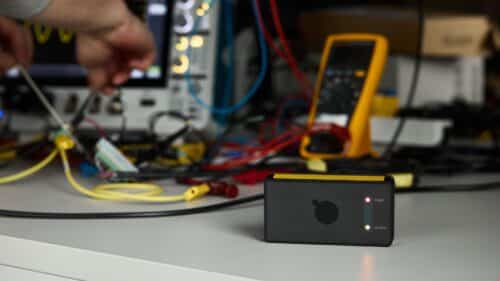
Sonair, a Norwegian robotics firm, has recently unveiled the ADAR One, claiming that it is the world’s first safety-certified 3D ultrasonic sensor for human-robot collaborations. The sensor targets Autonomous Mobile Robots (AMRs), humanoids, Autonomous Guided Vehicles (AGVs), and industrial automation equipment, giving 180° × 180° three-dimensional spatial awareness, enabling the detection of people and obstacles at all heights. Sonair claims that the sensor has been placed in series production, is already being used in industrial robots, and has been tested by over 80 robotics firms worldwide through Sonair’s test programme.
ADAR One employs Acoustic Detection and Ranging (ADAR) technology to resolve the problems of the blind spots and heights in common 2D safety sensors. It is claimed by Sonair that the sensor works independent of camera, AI software, and motion control systems and creates a certified 3D safety layer, validating the environment of a robot before and during operation. The compact design makes integration into robot platforms possible even for humanoid robots.
The firm states that this sensor has been tested and certified to meet some of the world’s toughest industrial safety standards set in the industry when it comes to detecting obstacles and persons in the surrounding area of robots. The sensor has also been approved under European machinery safety regulations on machinery safety and referred to as the first safety-certified embedded system developed using the Rust programming language. According to Sonair, this technology offers an alternative to traditional 2D laser sensors by adding 3D perception and decreasing the system’s complexity and costs.
The compact sensor can be integrated into system integrators who can integrate the sensors in AMRs, AGVs, collaborative robots, and humanoids without having to redesign them. According to Sonair, the technology could help create safer workplaces, reduce accidents, improve productivity and increase confidence in robots operating alongside people while meeting recognised safety requirements.
“This is precisely the role ADAR One is designed to play as a drop-in, pre-certified safety layer. What used to be an engineering burden is now transformed into a commercial differentiator for all stakeholders,” said Knut Sandven, CEO of Sonair, in a statement.
Click here for the original announcement.


