


Can chip architecture outperform advanced manufacturing? A newly launched AI processor points to an alternative route for future computing performance.
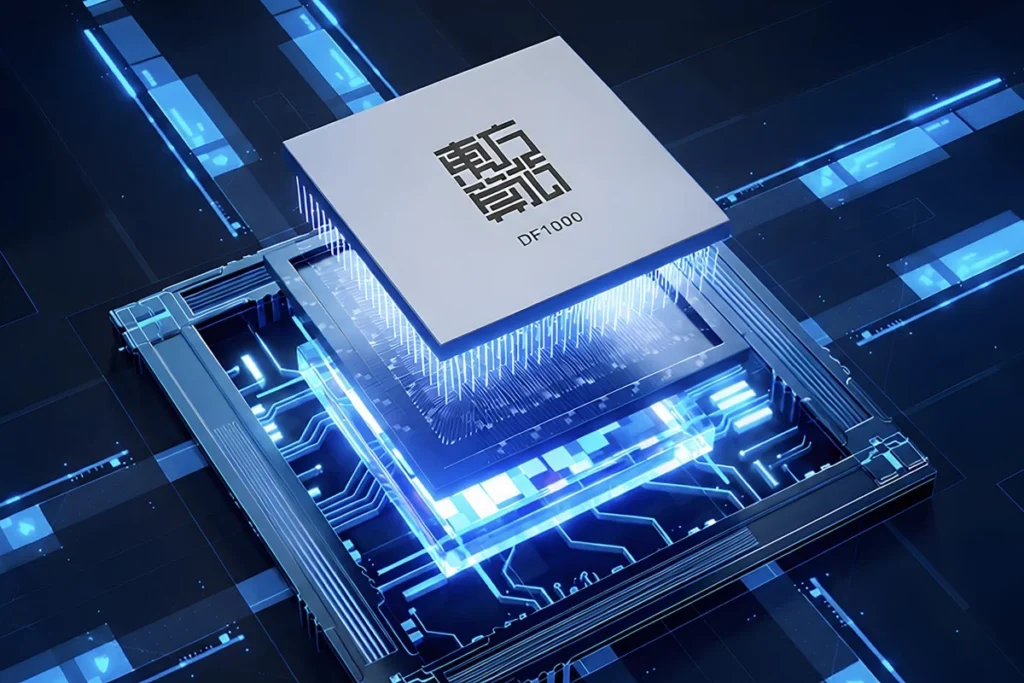
Shanghai-based semiconductor start-up Dongfang Suanxin has launched its DF1000 artificial intelligence (AI) processor, introducing a hardware platform built around software-defined computing and 3D-stacked near-memory architecture. Alongside the launch, the company unveiled a multi-generation roadmap aimed at improving AI performance through architectural innovation rather than relying solely on advanced semiconductor manufacturing technologies.
The announcement comes as semiconductor companies seek new approaches to overcome growing compute demands and manufacturing constraints. By redesigning data flow and placing memory closer to processing cores, the architecture aims to reduce data movement, lower latency, and improve energy efficiency for AI training and inference workloads. The strategy also reflects a broader industry shift towards optimising chip architecture as advanced fabrication nodes and high-bandwidth memory become increasingly difficult to access.
Built on a 14nm process, the DF1000 delivers 520 tera operations per second (TOPS) using the BF16 numerical format commonly used for AI model training. The processor offers 6.4TB/s of memory bandwidth and 900GB/s of inter-chip communication bandwidth. Dongfang Suanxin also introduced an ecosystem around the processor, including accelerator modules, AI supernodes, integrated computing appliances, and an open software stack compatible with mainstream AI development frameworks, custom operators, and clustered computing environments. The company plans to release the DF2000 in late 2026, followed by the DF3000 in 2027, with each generation targeting a significant increase in performance.
“We have to forge a path of our own. That path cannot be about passively catching up within a framework set by others. We need independent architecture, original technology, a self-sustaining ecosystem and a secure, controllable supply chain,” says Wei Shaojun, Founder of Dongfang Suanxin and Vice-Chairman of the China Semiconductor Industry Association.
Click here for the official announcement.