


Reference design provides a digitally programmable isolated flyback converter with wide input and output voltage ranges for industrial and automotive power applications.
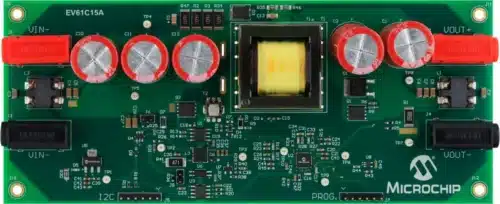
Microchip Technology has introduced a 100W isolated flyback converter reference design that will make it easier for engineers to develop digitally controlled DC-DC power converters. The reference design is based on an isolated flyback topology and can be used in various applications such as industrial, automotive, appliances, and data centers. Programmable output voltage and current are key features of this design along with galvanic isolation and power conversion efficiency.
This reference design uses the MCP19125 Digitally Enhanced Power Analog (DEPA) controller and has been designed to combine digital control and communication capabilities. The DEPA controller allows programming of the output voltage, current limit, overvoltage protection, over-temperature protection, and soft-start via an I2C interface. In addition to this, it comes with on-board monitoring of input voltage, input current, output voltage, output current, and board temperature.

Operating over a wide input-voltage range, the converter uses an input voltage ranging from 20V to 36V and supplies an output voltage range of 20V to 55V and a maximum output current of 2A. The switching frequency is approximately 120kHz and the converter attains an efficiency greater than 80% when at a nominal output current of 1A. Functional isolation of the input from the output not only improves safety, but also enhances its reliability in power application circuits.
The evaluation board includes banana connectors for input and output, I²C connector for communication, and the programming connector for firmware updates. With dimensions of 175mm × 73mm × 35mm, the board represents a convenient tool for evaluation of digitally controlled isolated power conversion and for the adaptation of the design for application-specific needs.

The reference design from Microchip is supplied with design files, a bill of materials, and supporting documentation to assist engineers with the shorter development time or reduced development time. Combining programmable control, isolated communication, on-board monitoring and configurative protection features makes the design suitable as a flexible foundation for isolated DC-DC converter development.
For more information, click here.