Can a ball sense goals, penalties and do the decision-making while a match is-ongoing? The sensor-embedded football used in FIFA World Cup 2026 does that in real time.
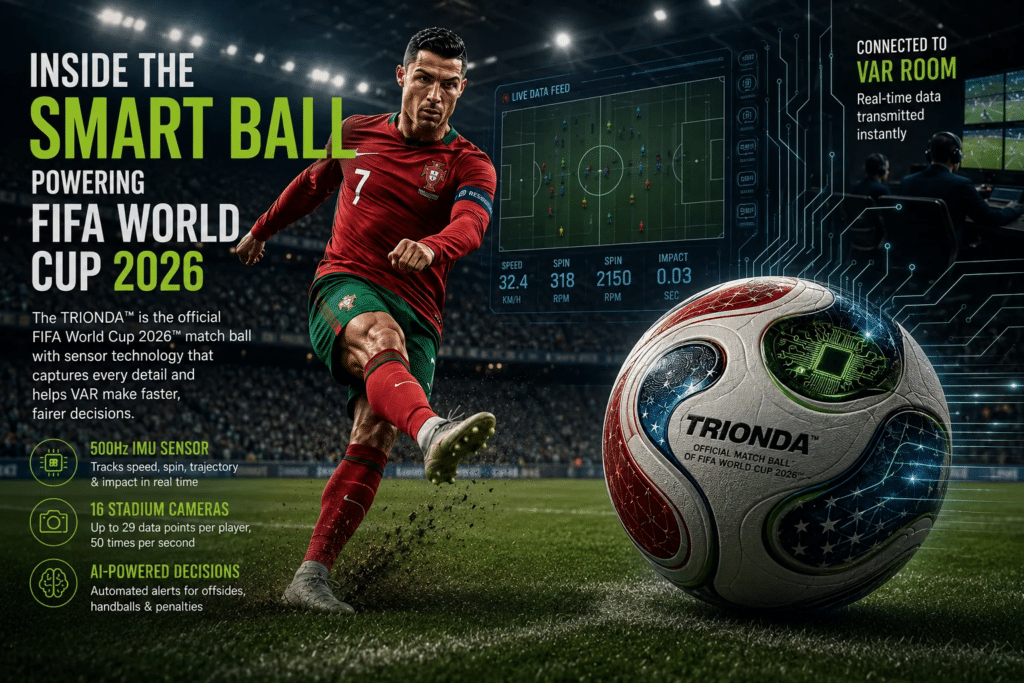
Fédération Internationale de Football Association (FIFA), in collaboration with Adidas and KINEXON, has developed the Trionda—the tournament’s official sensor-built-in match ball, which functions as a connected device.
The ball carries an embedded inertial measurement unit (IMU) that serves as its digital nervous system, continuously measuring motion and ball contact. The sensor data is processed by the ball’s onboard electronics and transmitted in real-time to the video assistant referee (VAR) system.
The integration marks an era where football is no longer relying only on human and VAR data, but is being supported by real-time sensor evidence. By bringing millisecond-level data into the world’s most-watched sport, the connected ball is redefining how crucial match decisions are made.
Evolution of the connected ball
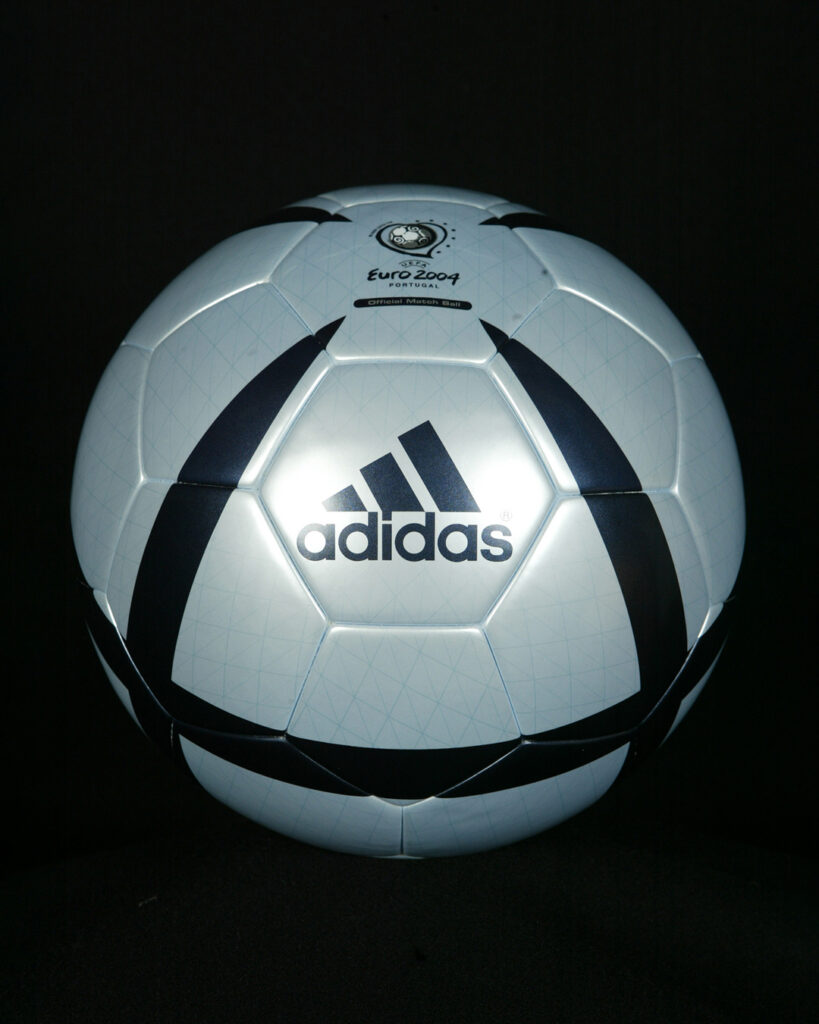
The journey began with the Adidas Roteiro, the official match ball of UEFA Euro 2004. Engineers suspended a microchip at its physical centre using tensioned cords, ensuring the sensor remained as balanced as possible.
As Bluetooth lacked the bandwidth and low-latency performance required at the time, the system instead relied on magnetic field technology. Thin cables buried underneath the penalty areas generated a localised magnetic field. When the ball completely crossed the goal-line, the sensor detected the change and transmitted an encrypted radio signal to the referee’s wristwatch within milliseconds, displaying “GOAL.”
The system was publicly trialled during the 2005 FIFA U-17 World Championship in Peru. However, integrating electronics into a football proved far from straightforward. Early prototypes shifted the ball’s centre of mass, causing it to wobble during backspin or drop unexpectedly, demonstrating that achieving accurate sensing without affecting ball performance was as challenging as the technology itself.
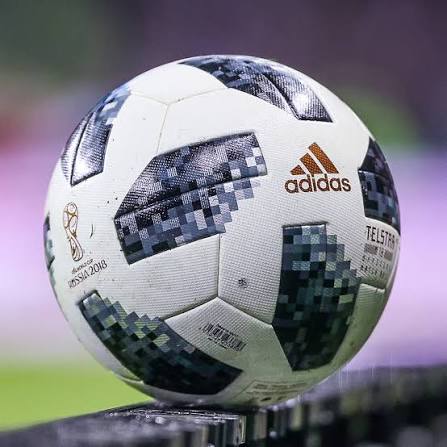
The next evolution came with the Adidas Telstar 18, which embedded a passive NFC chip within its outer layer. While it did not assist referees, it allowed fans to unlock digital content with a smartphone and, more importantly, proved that embedded electronics could withstand mass production and professional play.
The company then shifted away from costly stadium-based magnetic tracking towards measuring the ball’s interaction with the player’s foot. This led to the miCoach Smart Ball, a commercial training ball that used internal sensors to analyse strike power, spin, and trajectory.
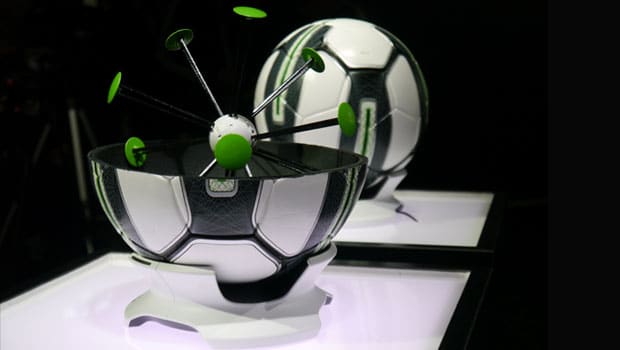
The breakthrough for competitive football came through Adidas’ partnership with KINEXON around 2020. By reducing the sensor package to just 3 grams and suspending it inside an internal exoskeleton, the technology debuted in the Al Rihla, the official match ball of the 2022 FIFA World Cup. It became the first football to deliver Connected Ball Technology, enabling precise ball-contact detection to speed up VAR offside decisions according to Adidas.
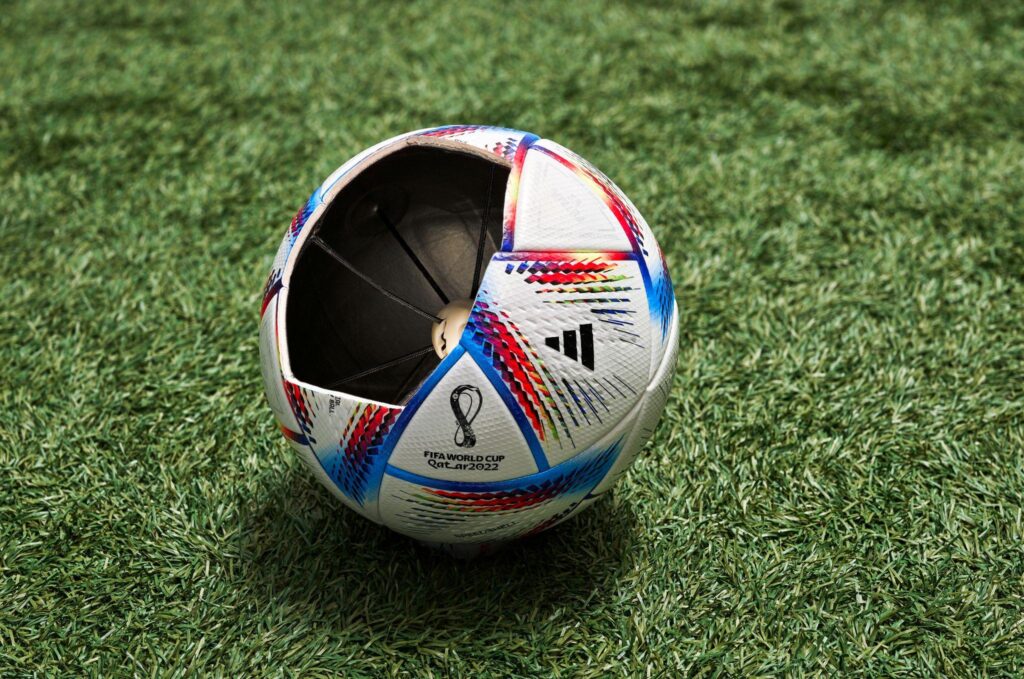
This evolution led to the Trionda detecting the exact moment of impact, making it possible to identify subtle handballs and provide a precise reference point for decisions.The ball’s data is synchronised in the cloud to automatically determine the exact instant of a pass, enabling highly accurate semi-automated offside decisions, according to U.S. News & World Report.
Breaking Down The Sensor Stack
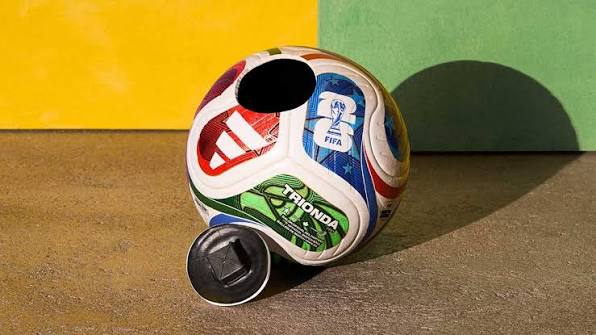
Unlike the 2022 Al Rihla ball, Adidas has miniaturised and embedded this electronics package directly into one of the ball’s four panels, with counterbalancing weights added to ensure the electronics do not alter its flight characteristics.
At the heart of the Trionda, according to a COMSOL blog, is a compact electronics module built around a 500Hz inertial measurement unit (IMU). The IMU integrates a three-axis MEMS accelerometer to measure linear acceleration and a three-axis MEMS gyroscope to measure angular velocity, enabling the ball to capture every kick, spin, rebound, and touch in real time. While Adidas and KINEXON have not disclosed the exact IMU used, commercially available devices with similar specifications support acceleration measurements of up to ±32g and angular velocities of up to ±4000 degrees per second, allowing them to withstand the extreme forces generated during powerful strikes.
The IMU also incorporates signal-conditioning circuitry, analogue-to-digital converters (ADCs), and an on-chip temperature sensor to compensate for thermal drift, ensuring measurement accuracy under varying playing conditions. The captured data is digitised, timestamped, and forwarded to the communication subsystem for wireless transmission.
Complementing the IMU is a local positioning module comprising an ultra-wideband (UWB) transmitter and antenna. By communicating with fixed anchor nodes positioned around the stadium, the UWB module determines the ball’s precise location and synchronises it with the IMU data to establish exactly when and where each contact occurs.
The electronics package is powered by an integrated miniature battery, forming a self-contained sensor stack that continuously streams real-time tracking data.
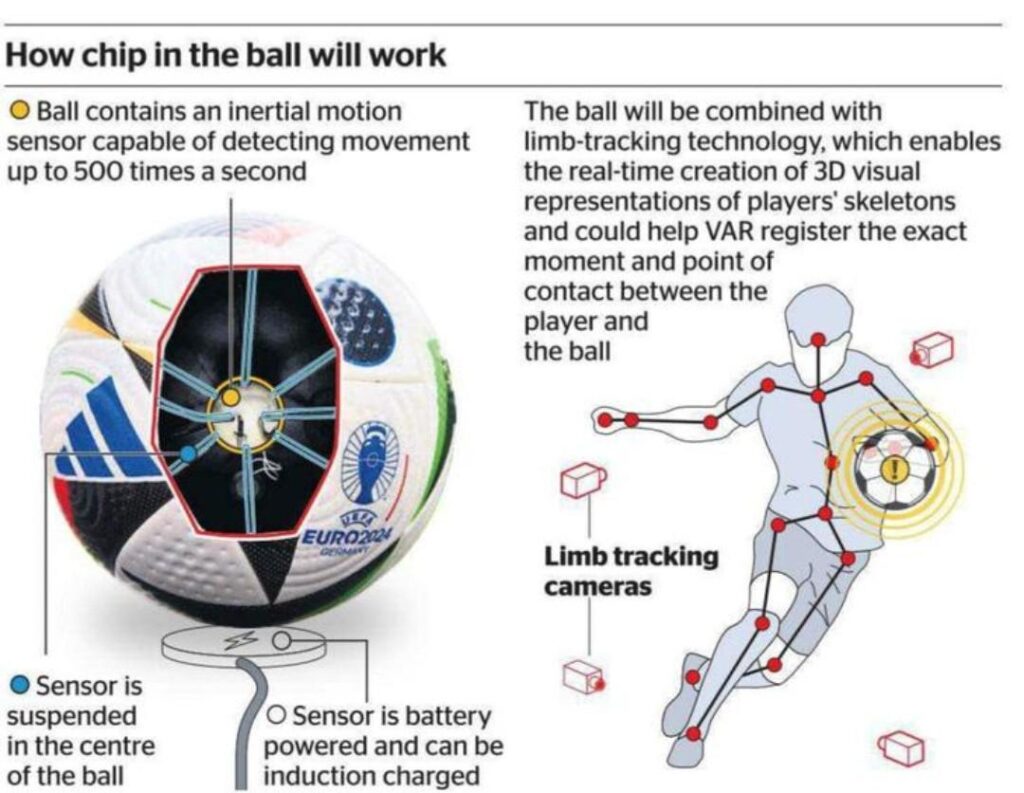
The sensor stack continuously records the ball’s speed, spin, trajectory, position, and the exact instant of every touch. This data is transmitted in real time to the Video Assistant Referee (VAR) system, where it is synchronised with player limb-tracking data from 16 stadium cameras to create a three-dimensional representation of on-field events. The fused dataset provides officials with precise timing and positional information for offside calls, handball decisions, and other critical incidents.
How the Ball Connects to VAR
Despite housing embedded electronics, the ball behaves identically to a traditional football, ensuring the player’s art remains uncompromised. The IMU sensor is exceptionally lightweight and rechargeable via induction, negating any impact on the ball’s weight or centre of gravity. Counterbalancing elements within the four-panel construction ensure the embedded electronics do not affect its symmetry, flight, or handling.
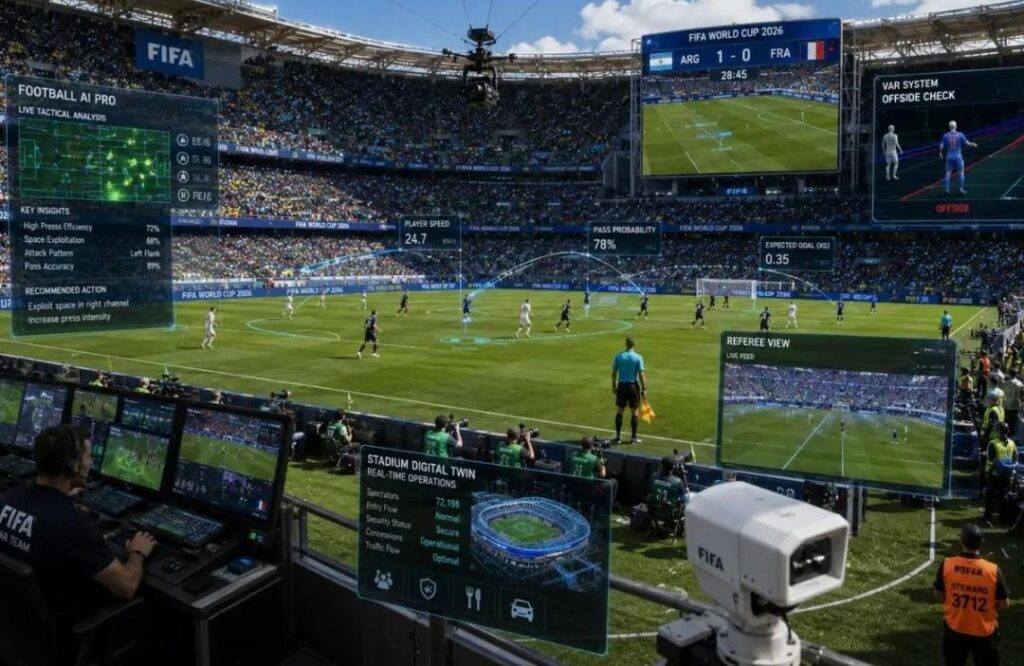
The ball does not work in isolation and is the central node of the technological ecosystem. The system integrates with 16 dedicated tracking cameras mounted inside the stadium, which monitor both the ball and the players. These cameras collect up to 29 data points per player, 50 times per second.
An AI engine processes this combined dataset, merging the ball’s internal metrics with the external player-tracking data, generating automated, real-time alerts for the VARs regarding potential infringements and penalties, cutting down the review times.
More players join the smart ball race
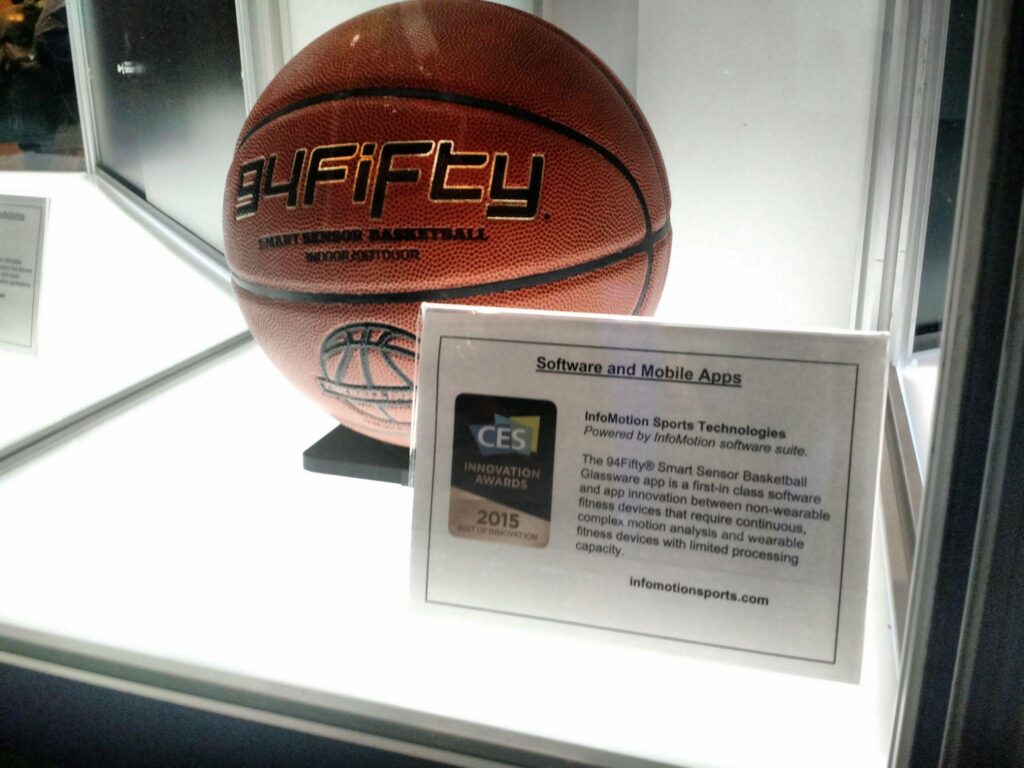
While football drove global visibility, basketball was the first sport to commercialise the concept. In 2013, InfoMotion‘s 94Fifty Smart Basketball demonstrated that sensors, Bluetooth connectivity, and wireless charging could be integrated into a regulation-weight ball without affecting its balance. Its patented design housed a 9-DoF sensor inside a flexible internal cavity that absorbed pressure changes while protecting the electronics.
The concept quickly expanded across sports. Wilson’s X Connected Basketball used onboard accelerometers to recognise successful shots without requiring instrumented hoops, while InsideCoach introduced one of the first Wi-Fi-enabled smart footballs, allowing coaches to monitor training sessions over larger playing fields. By 2018, Coach Labs had miniaturised similar electronics into a golf ball, embedding a 9-axis sensor and microcontroller inside its solid core.
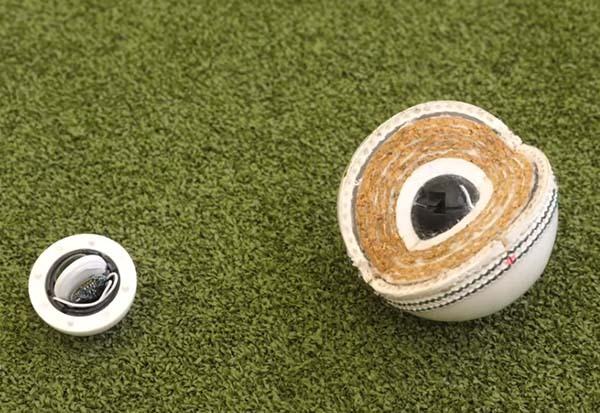
The following year, smart ball technology entered cricket. SportCor, in partnership with Kookaburra, replaced the traditional cork centre with a sensor-equipped core capable of surviving 150 km per hour deliveries while measuring pre- and post-bounce speed. Around the same time, myBall introduced inductive wireless charging beneath the leather shell, eliminating external charging ports and preserving the ball’s structural integrity.
Behind these products lies a specialised supply chain. Companies such as KINEXON develop ultra-light sensor modules and stadium positioning systems that power connected match balls, while firms including Blast Motion and Zepp Labs provide motion-sensing platforms licensed across multiple sports brands. Large-scale electronics manufacturing is handled by specialised ODMs such as Rocket PCB, which produce flexible, shock-resistant PCBs and protective packaging capable of withstanding the repeated high-impact deformation experienced during play.
| When sensor played the deciding factor |
| • Croatia’s Equaliser Ruled Out: During the Portugal vs Croatia Round of 32 match at the 2026 FIFA World Cup, the Trionda’s 500Hz IMU became the centre of one of the tournament’s biggest controversies. Croatia’s late equaliser was overturned after the embedded sensor detected a slight touch in the build-up to the goal. The contact could not be conclusively verified using broadcast footage alone, but when synchronised with player-tracking data, the sensor established a new phase of play, leading VAR to correctly rule the goal offside. • Overhead Camera Controversy: During the England vs Norway quarter-final, Norwegian players claimed the ball had struck an overhead cable supporting a robotic broadcast camera before England’s equalising move. FIFA reviewed the Trionda’s embedded sensor data, which showed no impact signature, confirming that the ball had not made contact with the cable. The sensor data allowed officials to dismiss the appeal and let play stand. |
Beyond football
The Trionda is more than just a ball; it is proof that the future of sports can be deeply digitalised, analysed, and enhanced through connected sensing and real-time analytics, setting a new digital standard for sports manufacturers, OEMs, and the spectator experience.
Reflecting on its role in the tournament, Sam Handy, General Manager, Football at Adidas, said, “We have the long-standing privilege of creating the one product that will be at the centre of every game, goal and moment during the tournament – the Trionda.”
The technology also signals opportunities beyond elite football. In India, companies such as Flickit are already developing sensor-enabled football training systems for player analytics and coaching, while the country’s growing strengths in semiconductor design, embedded systems, and EMS could position it as both a technology developer and manufacturing hub for the next generation of connected sports products.