




A new reference design combines integrated motor control, CAN connectivity and field-oriented control to improve drone propulsion efficiency, responsiveness, reliability and development speed.
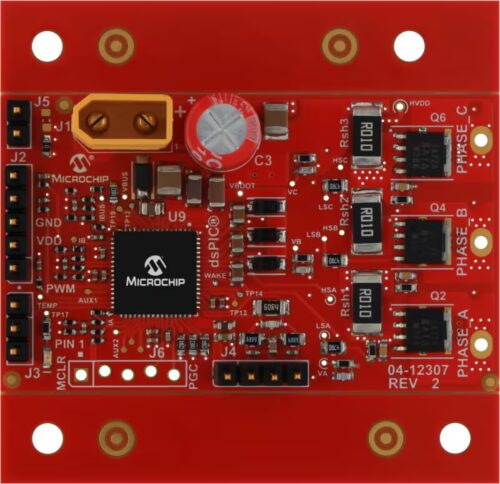
Microchip Technology has introduced its Drone 3S Electronic Speed Controller (ESC) Reference Design, a development and evaluation platform built to drive three-phase permanent magnet synchronous motors (PMSMs) and brushless DC (BLDC) drone propeller motors. Designed around the dsPIC33CDVC256MP506 Digital Signal Controller (DSC), the reference design supports CAN-controlled operation while targeting improved acceleration, torque control and reduced operating noise.
The design employs sinusoidal Field-Oriented Control (FOC) rather than conventional trapezoidal control, enabling smoother motor operation and enhanced dynamic response during acceleration. An integrated System-in-Package (SiP) combines the DSC, an MCP8021 three-phase MOSFET gate driver with LDOs, and an ATA6563 CAN FD transceiver to reduce board complexity while delivering a compact motor-control solution.
The reference platform incorporates a three-phase motor-control power stage alongside DC bus current and voltage feedback for over-current and over-voltage protection. It also provides phase-voltage feedback to support sensorless trapezoidal control, an In-Circuit Serial Programming (ICSP) header for programming and debugging, a UART communication header and a CAN interface integrated within the controller.
According to Microchip, the solution is intended to improve dynamic motor performance while lowering electromagnetic interference (EMI) and acoustic noise. The integrated architecture also enhances stall handling and protection, making the platform suitable for evaluating propulsion systems used in drones, robotics and industrial motor-control applications.
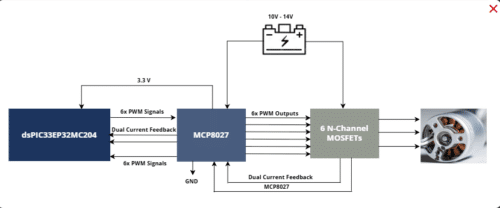
The reference design includes a solution diagram illustrating the interaction between the digital signal controller, gate driver, MOSFET stage and motor. Supporting documentation, including a dedicated user guide, is provided to assist engineers with hardware evaluation and application development.
By combining integrated motor control, CAN communication and advanced control algorithms in a compact reference platform, the design aims to shorten development time and help engineers build efficient, responsive and reliable electronic speed controllers for next-generation drone propulsion systems.
Click here to view full reference design.