

Projector lamp lifespan is an important consideration for projectors used in educational institutions, offices, and modern homes. Their ability to display content on a massive scale makes them invaluable tools for presentations, entertainment, and learning. While various factors can affect a projector’s performance, the lamp stands out as one of its most critical components. The device’s overall efficiency depends heavily on this single element. However, many users face a common challenge: How can it be determined whether a projector’s lamp is still operating at peak efficiency? How long will it continue to function? Or how can its usable lifetime be predicted without waiting for serious performance issues to arise?
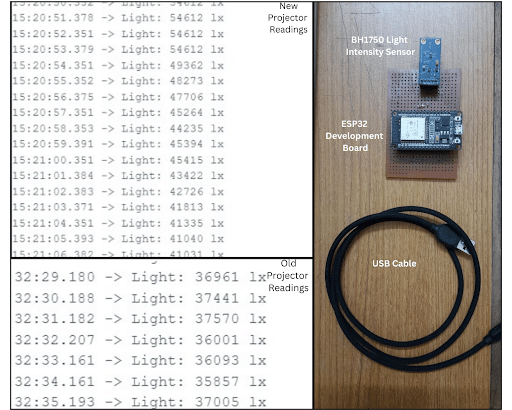
The proposed setup is used to check the luminous intensity of the light beam emitted by a projector lamp. As ambient light can affect the performance and, consequently, the readings, taking measurements of the lamp’s intensity in broad daylight would have presented a challenge. To ensure suitable environmental conditions during testing, the Physics Dark Room of the institute was used for the aforementioned task. The intensity of a new projector, less than two years old, and a comparatively older projector, more than six years old, was measured with the help of a BH1750 Light Intensity Sensor to analyse the condition of the lamps. Their comparative readings were also displayed. Based on these measurements, the remaining lifetime of the lamp can be predicted.
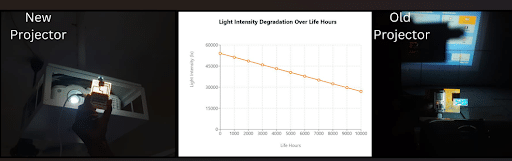
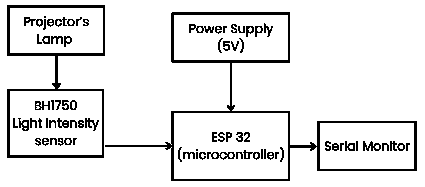
Figure 1 shows the experimental setup; the projector images appear significantly darker because of the dark-room conditions. It illustrates the striking comparison between the two projectors at different stages of their lifecycle. Figure 3 shows the block diagram representation of the setup. The measurements were taken at a distance of 4–5 cm from the screen in both cases.
Conventional projector models require manual monitoring, leaving users uncertain about the remaining lifespan of their lamps and often resulting in unexpected performance issues. However, modern projector technology has transformed this situation by incorporating sophisticated sensor systems and comprehensive digital monitoring capabilities.
Today’s projectors feature an intuitive ‘Information’ menu that tracks lamp hours and other vital performance metrics. While older models still in service can display this information through a specific manual process—holding the power button for approximately 20 seconds—newer systems actively monitor lamp degradation and automatically alert users when maintenance is required.

This technological evolution is particularly evident in how lamp deterioration is detected, especially when the projected image begins to lose its brilliance or the overall quality starts to decline. These advancements enable users to maintain optimal brightness and image quality by replacing the lamp at the appropriate time, eliminating the guesswork associated with traditional systems.
As time progresses, projector lamp deterioration becomes visible through increasingly darker and duller projected images, providing a clear indication that lamp replacement may be necessary.
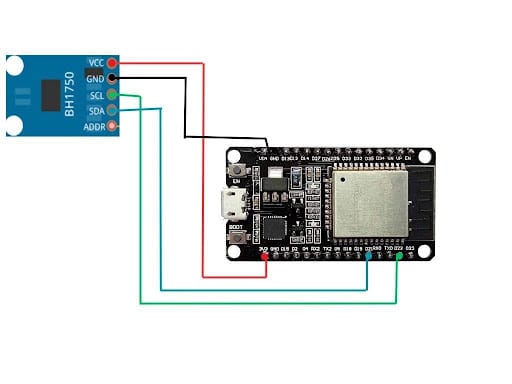
The integration of the BH1750 sensor represents a simpler approach with an external interface, offering a precise method for measuring lamp light intensity and providing a reliable alternative for assessing projector lamp lifespan, particularly for older models that do not display lamp lifetime information in the Information menu. Tables 1 and 2 present the Bill of Materials and the pin functions of the ESP32 microcontroller, respectively.
Bill of materials
Table 1 contains the list of components required for the project:
| Components | Amount | Description |
| ESP32 | 1 | For programming |
| Light intensity Sensor (BH 1750) | 1 | To detect intensity |
Board Labels and Pin Functions of ESP32
Table 2 Contains the labels and pins of the ESP32:
| Connections Light intensity Sensor (BH 1750) and ESP32 | ||
| Board label | Pin function (BH 1750) | ESP32 |
| GND | GROUND | GND |
| VCC | 3.3 Power Input | 3V3 |
| SDA | Serial Data Line | D21 |
| SCL | Serial Clock Line | D22 |
About the BH1750 Light Intensity Sensor
The BH1750 is used to measure the intensity of the projector lamp. It is suitable for detecting ambient light levels in various environments. It can accurately measure visible light from various sources, including sunlight, indoor lighting, LEDs, and reflected light.
It can be used in applications where the amount of visible light needs to be monitored and connects easily to microcontrollers via an I2C interface. It is a digital ambient light sensor that converts light intensity into a digital output signal measured in lux (lx).
The BH1750 is designed to sense visible light in the spectrum from approximately 400nm to 700nm, matching the sensitivity range of the human eye.
It has a wide measurement range of 1–65,535 lux and uses a 16-bit resolution, with a resolution of up to 1 lux. It is often used to adjust the backlighting of mobile phones. Its operation can be understood using the block diagram shown in Figure 4.
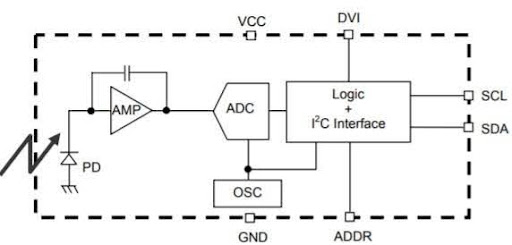
The sensor uses a photodiode to sense light. This photodiode contains a PN junction specifically designed to collect light. When light falls on it, electron-hole pairs are created in the depletion region. Due to the internal photoelectric effect, an electric current is produced in the photodiode. This current is proportional to the intensity of the incident light. The current is converted into a voltage by the operational amplifier. The light level is measured based on its intensity.
The BH1750 uses an analogue-to-digital converter to convert the analogue values provided by the amplifier into digital values. The Logic + I2C block shown in the block diagram is the unit where illuminance values are converted into lux and the I2C communication process takes place. An internal clock oscillator operating at 320kHz is used as the clock for the internal logic.
There are three types of measurement modes available in the BH1750. H-resolution mode 2 takes 120ms for measurement and provides a resolution of 0.5 lx. H-resolution mode also takes 120ms for measurement but provides a resolution of 1 lx. L-resolution mode takes 16ms for measurement and provides a resolution of 4 lx. H-resolution mode is more useful in low-light conditions and can also effectively reject noise. H-resolution mode of measurement was selected for measuring the light intensity. The circuit diagram is shown in Figure 5.
Specifications of the Sensor
- The power supply needed is 2.4V -3.6V with a nominal current of 0.12mA.
- No additional calculations are required to measure the intensity of light, direct digital values are available due to its internal 16-bit ADC.
- BH1750 can measure light intensity up to the range of 65535 lx units.
- This sensor uses the I2C communication protocol to send data to the microprocessor.
- IR radiation has very less effect on the measurements of this sensor.
- BH1750 does not depend on the light source used.
- BH1750 has a 50Hz/60Hz Light noise rejection function.
- The measurement range of the sensor is adjustable.
- BH1750 has a very small measurement variation that is about +/- 20%.
- The operating temperature range of this sensor is from -40°C to 85°C.
- The minimum I2C reference voltage is 1.65V.
- This sensor works with a 400kHz of I2C clock frequency.
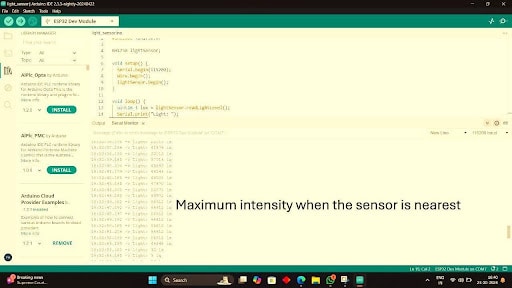
Additionally, for the new projector, the sensor was gradually moved from a distance of 5 cm towards the screen and then back to the 5 cm position. The corresponding readings are shown in Figure 6.
Code
#include <Wire.h>
#include <BH1750.h>
BH1750 lightSensor;
void setup() {
  Serial.begin(115200);
  Wire.begin();
  lightSensor.begin();
}
void loop() {
  uint16_t lux = lightSensor.readLightLevel();
  Serial.print("Light: ");
  Serial.print(lux);
  Serial.println(" lx");

  delay(1000);
}
About Authors: Dr. Geetali Saha is a faculty of the department of Electronics and Communication Engineering, GCET, Anand, Gujarat and Urvi Patel from Final Year Computer Science and Engineering (IoT) Department has successfully executed this task.