A new iron-air battery system charges and supplies power for long hours, offering a way to store renewable energy for daily use.
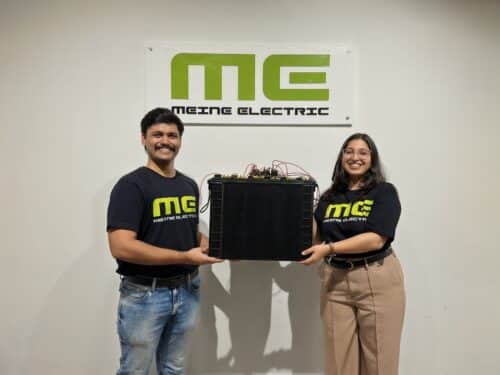
Indian deep-tech startup Meine Electric has developed an iron-air battery system that can charge in six hours and discharge for 18 hours. The company says the technology is the world’s first fast-charging iron-air battery system designed for daily-cycling renewable energy applications.
The system uses Meine Electric’s proprietary Fast Charge Long Discharge (FCLD) technology, along with its electrode development process and system architecture. Its performance has been independently validated by Customised Energy Solutions (CES), a US-headquartered energy services and technology company and the parent organisation of the India Energy Storage Alliance (IESA).
Testing was conducted at the CES Battery Laboratory using two iron-air electrochemical cells. The testing protocol evaluated electrochemical performance, capacity retention, and operational stability. The cells were tested under a six-hour charging and 18-hour discharging cycle.
Iron-air batteries are being developed for long-duration energy storage because they use abundant materials such as iron. Companies including Form Energy in the US and Ore Energy in Europe are developing iron-air systems for long-duration storage, with some systems targeting storage durations of up to 100 hours.
However, longer charging cycles can limit the use of iron-air batteries for daily renewable energy balancing. Meine Electric says its FCLD technology addresses this limitation by reducing the charging time to six hours while maintaining an 18-hour discharge period.
The company says the technology can support daily renewable energy storage, allowing electricity generated from sources such as solar and wind to be stored and supplied over an extended period.
“Traditional iron-air systems are restricted to multi-day cycles, making them largely incompatible with the intermittent nature of renewable energy generation. Furthermore, solar-heavy grids don’t need a 100-hour battery. Unlike regions that require seasonal storage, the renewable challenge across Asia and MEA is fundamentally a daily balancing problem. By engineering our system to capture a full charge within a tight 6-to-8-hour window, we are finally turning iron-air batteries from a sluggish backup chemistry into a foundational, daily-cycling asset,” said Priyansh Mohan, Co-founder and CEO of Meine Electric.
In addition to the faster charging cycle, the iron-air chemistry offers the use of abundant raw materials and avoids some of the material constraints associated with lithium-ion batteries. Meine Electric also says its system has inherent safety advantages and can achieve lower system costs than lithium-ion-based storage.