




Reference design integrates an 11 kW three-phase onboard charger and 2.5 kW low-voltage converter for bidirectional electric vehicle power applications.
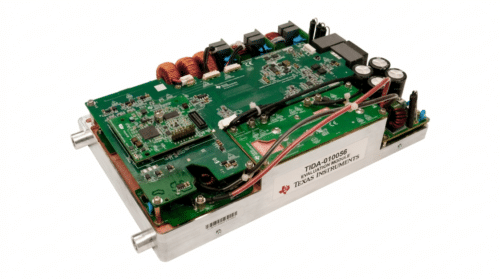
Texas Instruments has developed a reference design that integrates an 11 kW three-phase onboard charger with a 2.5 kW low-voltage DC-DC converter. The design uses a single-stage series-resonant dual-active-bridge AC-DC topology and is intended for automotive applications requiring bidirectional power conversion. It supports vehicle-to-grid, vehicle-to-load and grid-to-vehicle power transfer, providing a platform for evaluating high-power charging and auxiliary power conversion.
The onboard charger has a three-phase AC input ranging from 175 V to 264 V per phase, with a nominal input voltage of 220 V. It has a maximum output power of 11 kW and a peak efficiency of 97.5 per cent. The high-voltage DC battery side has an operating voltage range of 450 V to 850 V. The converter uses a series-resonant dual-active-bridge topology that supports zero-voltage and zero-current switching for efficient power conversion.
The resonant stage operates at a nominal frequency of 150 kHz, with an operating range of 80 kHz to 250 kHz. The high operating frequency enables high power density, while the bidirectional topology allows energy to flow between the vehicle and the connected power system. The charger supports grid-to-vehicle, vehicle-to-load and vehicle-to-grid power transfer applications.
The design also incorporates a low-voltage DC-DC converter offering up to 2.5 kW of power and a nominal output voltage of 14 V. One microcontroller performs closed-loop control of the onboard charger and low-voltage converter. A single microcontroller handles closed-loop control for both converters. Its Type-5 ePWM peripheral is what makes this possible it’s built to handle the tricky multi-phase switching pattern the three-phase design requires, without needing separate control hardware.
Texas Instruments provides documentation for the reference design, including architectural details and verified performance data with the evaluation hardware. The reference design provides engineers with a platform to evaluate three-phase bidirectional power conversion and develop automotive charging systems combining high-voltage battery charging with low-voltage power conversion.
For more information, click here.

