




A dual-port USB-C charger delivers up to 90W, shares power between ports, and protects devices from heat, voltage, and current issues.
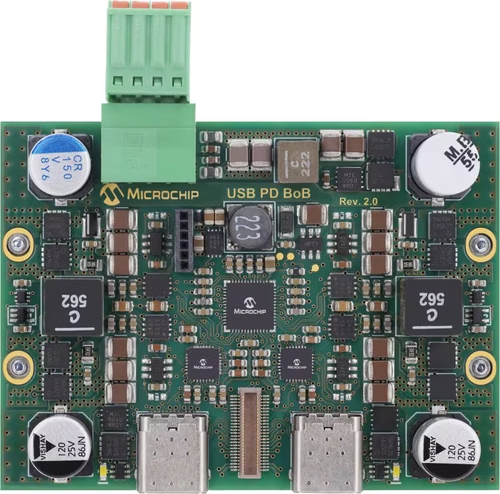
Microchip’s USB-C Power Delivery (USB-PD) reference design provides a dual-port charging solution for automotive and other systems that need to power multiple USB-C devices. It delivers up to 60W per port, with a combined output of up to 90W when both ports are used. The design accepts a 9–18 V input and supports output voltages up to 20V and currents up to 3A.
The reference design uses a single digital signal controller (DSC) to manage the USB-PD software stack and power conversion for both ports. Its software-based architecture supports charge balancing, thermal management, voltage regulation and efficiency improvements while allowing the power-conversion hardware to be adapted for different system requirements.
Power is balanced between the two USB-C ports based on the connected loads. The design uses real-time voltage and current measurements to manage power delivery. VBUS line-drop compensation helps maintain the required output voltage, while configurable thermal management helps control temperature and maximise available power.
The reference design supports standard USB-PD output levels of 5V, 9V, 15V and 20V, along with USB-PD Programmable Power Supply (PPS). It includes overvoltage, overcurrent and short-circuit protection, as well as intelligent load monitoring to help protect connected devices.
For electromagnetic interference (EMI) control, the design supports optional switching-frequency dithering. The switching frequency is around 350 kHz. The solution can deliver maximum power at up to 97 per cent efficiency.
A graphical user interface (GUI) allows developers to monitor parameters such as input voltage and current, output voltage and current, and temperature. It can also be used to configure output-voltage options and protection features during debugging.
The DSC-based architecture is topology-independent, allowing designers to change or optimise the power-conversion stage for different applications. Supported configurations include four-switch buck-boost converters, common step-up/independent step-down converters and semi-isolated single-ended primary-inductor converter (SEPIC) topologies.
The design supports up to four USB-PD ports and can be customised to meet different original equipment manufacturer (OEM) requirements. Optional USB 3.0 hub connectivity can extend the USB-PD platform to support additional USB functions.
For automotive applications, the design can integrate with vehicle systems through controller area network (CAN) and local interconnect network (LIN) interfaces. The reference design is intended to help developers build multi-port USB-C charging systems with power balancing, thermal management, protection and configurable power-conversion options.
Microchip has tested this reference design. It comes with a bill of materials (BOM), schematics, assembly drawing, printed circuit board (PCB) layout, and more. The company’s website has additional data about the reference design. To read more about this reference design, click here.