




An open source quadruped uses modified hobby servos, custom PCBs and a 200Hz control loop to bring closed-loop robotics to a DIY build.
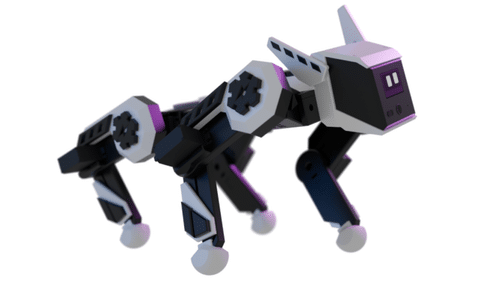
A four-legged robot that can be 3D-printed, programmed, and modified at home is being built around a single ESP32-S3. Called the TNY-360, the open source quadruped combines 12 modified MG996R servos, custom electronics, and closed-loop control to create a more capable alternative to conventional hobby robot dogs. The project is being developed by maker Paul Loisil, with its firmware, electronics, and mechanical designs published for others to study and modify.
The key difference is that the TNY-360 does not simply tell its servos where to move and assume they reached the requested position. Its MG996R servos are modified to expose their internal position feedback. A small custom PCB using an operational amplifier buffers the potentiometer signal before it reaches the ESP32-S3. This allows the controller to continuously monitor the position of the joints without interfering with the servo’s own control circuit.
The approach gives the robot a 200Hz closed-loop control system. One ESP32-S3 core is dedicated to the real-time kinematics and control loop, while the other handles tasks such as WebSockets, the user interface, and system orchestration. The maker says this architecture allows all 12 leg joints to be monitored and controlled at high speed.
The robot has 12 MG996R servos for its legs, driven through a PCA9685 16-channel PWM controller. The current project documentation also lists an ESP32-S3 N16R8 module, a 3S battery built from six Samsung INR18650-25R cells, and an INA219 voltage and current sensor.
Its sensor system includes an OV2640 camera, a VL53L0X time-of-flight distance sensor, an LSM6DS3 six-axis IMU, and a 128×64 SSD1306 OLED display. The latest documentation also lists an I2S MEMS microphone and speaker, expanding the platform beyond basic walking and towards interactive robotics. Some components listed in earlier versions of the project, including the MPU6050 and SH1106 display, have since been replaced in the current specification.
The closed-loop system was developed partly to avoid the cost of smart servos. According to the maker’s engineering log, directly reading the potentiometer inside an MG996R caused unstable behaviour because the controller’s ADC could disturb the signal. Electrical interference from the motors and power wiring also affected the readings. The custom op-amp buffer provides a low-impedance output while preventing the measurement circuit from significantly loading the servo’s potentiometer.
The project also evolved from a wiring-heavy prototype into a modular electronics platform. Custom PCBs divide functions between the robot’s control, sensor, motor, and power systems, with JST-PH connectors replacing much of the earlier Dupont wiring. This makes the electronics easier to assemble and reduces loose wiring inside the moving chassis.
For creators who want to build the robot themselves, the repository contains firmware, PCB designs, and mechanical files. The project documentation provides FreeCAD and printable 3D files, while the firmware is based on ESP-IDF and uses C++. The repository also includes a servo-modification guide explaining how to add position feedback to the MG996R actuators.
Programming is not limited to writing embedded code. The TNY-360 can be controlled through the project’s TNY-Coder block-based web application, while the official website also lists native Python and JavaScript/TypeScript SDKs and ROS 2 integration. This gives the same hardware a progression from visual programming to more advanced robotics development.
The robot also includes automatic calibration features. Mechanical end stops help validate assembly, while the firmware can compensate for effects such as actuator backlash and latency. A dorsal I2C and power expansion port provides another way to add custom hardware to the platform.
The project is still an engineering platform rather than a polished consumer robot dog. Building one requires 3D printing, electronics assembly, servo modification, and battery construction, while the current repository notes that some V2 mechanical, PCB, and CAD files are still being prepared. The project is also licensed under CC BY-NC-SA 4.0, allowing sharing and adaptation for non-commercial purposes with attribution and share-alike requirements.
For Indian robotics students and makers, the TNY-360 is particularly interesting because its architecture is based on components commonly encountered in hobby electronics and college robotics projects. Instead of buying a closed robot platform, users can inspect the electronics, modify the mechanical design, and experiment with the control software themselves.
The project has now moved to TNY-360 V2, with kits available for preorder. The official website lists a €289 BareBones option, a €399 Maker kit and a €599 fully assembled Ready2Run version, although the latter is currently marked as coming soon.
The bigger idea behind the TNY-360 is not simply building another robot dog. By combining inexpensive hobby servos with position feedback, a fast ESP32-S3 control loop, and open hardware, the project shows how makers can approach features normally associated with more expensive robotic platforms without locking themselves into proprietary hardware.
For more information, click here.


