

An implantable sensor developed by Phantom Neuro detects forearm muscle signals and transmits them wirelessly to a prosthetic limb, with its first human implants marking an early clinical milestone.
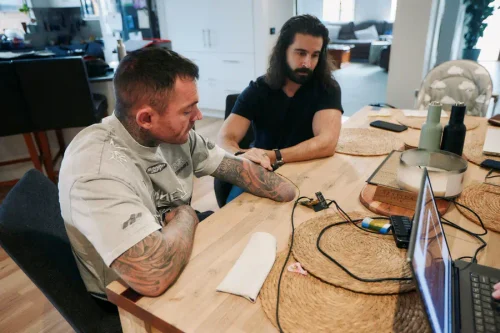
Two people with upper-limb loss in Australia have received Phantom X, an investigational implant designed to help users control powered prosthetic arms using muscle signals. Developed by US-based Phantom Neuro, the device sits beneath the skin over muscles in the residual limb and translates electrical activity associated with intended movements into commands for a compatible prosthesis. The first implantations took place at Cabrini Health in Melbourne as part of the company’s CYBORG early feasibility study.
The implant uses electromyography (EMG) to detect electrical signals generated by muscles when a person attempts to move a missing hand or wrist. It consists of a flexible medical-silicone strip containing two rows of electrodes and a small electronics module that processes signals and transmits them wirelessly. Power is supplied through an external system using an inductive coil. The device measures approximately 2cm by 10cm. Machine-learning software interprets the recorded signals to associate muscle activity with particular gestures.
Unlike conventional myoelectric prostheses, which typically use electrodes positioned against the skin inside the socket, Phantom X places its sensors beneath the skin, closer to the muscles. Surface electrodes can be affected by sweat, skin movement and changes in socket fit, potentially reducing signal consistency and requiring recalibration. The implanted approach is intended to address these challenges without the brain surgery associated with some brain-computer interfaces. However, implantation introduces its own surgical and engineering considerations, including long-term tissue compatibility and reliable wireless power delivery.
The initial procedures reportedly took about an hour each and were performed without general anaesthesia, according to Phantom Neuro. The first participant, Michael Easy, is a 32-year-old carpenter from Victoria, Australia. The company has reported encouraging initial signal quality, but the study is still evaluating the technology. The implant currently has limitations in combining movements, such as rotating the wrist while closing the fingers, and further testing is needed to establish how reliably it can control prosthetic limbs during everyday activities.

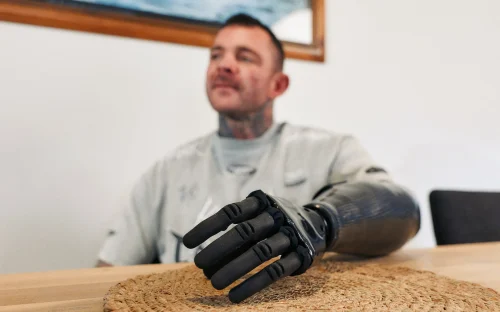
Registered as NCT07325708, the CYBORG study is designed to evaluate the safety and functional performance of the Phantom X implantable EMG sensor system. The device remains investigational and is not approved for commercial use. Its first human implantations do not establish long-term safety or prove that it improves prosthetic control over existing approaches.
For India, where affordability remains a major consideration in prosthetic care, the technology highlights a potential route to improving muscle-signal detection for powered limbs. Indian developers working on myoelectric prostheses could follow advances in implanted sensors and signal-processing systems, while evaluating whether similar control performance can be achieved using less expensive, non-invasive approaches. Phantom Neuro has not announced an Indian trial or pricing for the device.
For more information, click here.