




BEML is developing an indigenous eight-coach high-speed trainset in bengaluru, designing for testing at up to 280km/h and operation at 249km/h.
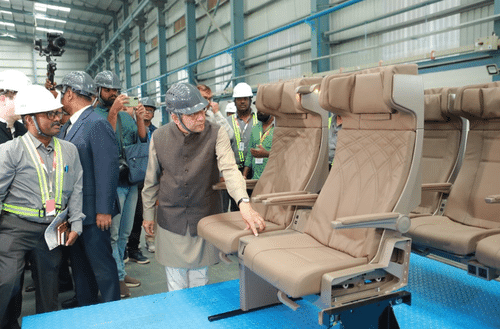
The first bullet train ever developed in India has become a recognizable train. Ashwini Vaishnaw, who is the Minister of Railways, visited BEML Factory at Bengaluru on 1st November to review the development of the high-speed train.
The train’s length will be 202 meters and this train have eight coaches. Four of these coaches will be motor coaches while the other four will be trailer coaches. This train would carry a capacity of around 557 people. The train will comprise seven coaches of standard class with three and two seating and one coach of executive class with two and two seating. Its maximum test speed will be 280km/h while its operating speed will be 249km/h.
There are ergonomic seats that fit well within Indian body structures, large windows, LED lights, charging points and luggage racks in the passenger cabins. Two air-conditioners will be fitted in each coach. There will be Wi-Fi-based infotainment, passenger information systems in English, Hindi and regional languages, automatic announcement and emergency communication systems. There will be features for disabled persons that include level boarding, wheel chair friendly doors, disabled passenger facilities and Braille signs.
With regard to its engineering perspective, this rail vehicle has been built with a one-phase AC system of traction whose power supply originates from the overhead power lines that operate at 25kV and 50 Hz. The train has been designed with regenerative brakes which can recover any energy losses that occur during the braking process. The nose and the body have been optimized aerodynamically through CFD simulation.
The project is being undertaken by a consortium comprising BEML and Medha Servo Drives and has been contracted by ICF, Chennai, with an award of ₹866.87 crores in October 2024. The contract concerns the design, manufacture, and commissioning of two eight-coach high-speed trains. In addition, it includes development expenses, tools, jigs, and testing equipment capable of meeting future demands for high-speed rail systems in India.
The train is still undergoing manufacturing and structural testing. The integrated car body is undergoing a squeeze test to assess its strength and ability to withstand external forces. Once this stage is completed, propulsion systems and other electronic equipment will be installed, followed by climate testing under extreme temperatures, rain and dusty conditions.
Track testing is planned for the first quarter of FY2027–28, with the 100km Surat–Vapi section identified for testing. Commercial service will start in August 2027 depending on the success of tests. The total stretch of 508km between Mumbai-Ahmedabad will be completed by December 2030. Plans are underway within Indian Railways for B35 trainset which is supposed to travel at 350km/h.
For India, the B-28 represents an important step towards developing domestic high-speed rail technology. However, its actual performance, passenger experience and operational reliability will become clearer only after testing on dedicated high-speed tracks. The extent of locally manufactured components and the eventual ticket prices have not yet been disclosed.
For more information, click here.
