What happens when a century-old aerodynamic concept meets electric propulsion and tilting rotors? A flight test puts the combination to the test.
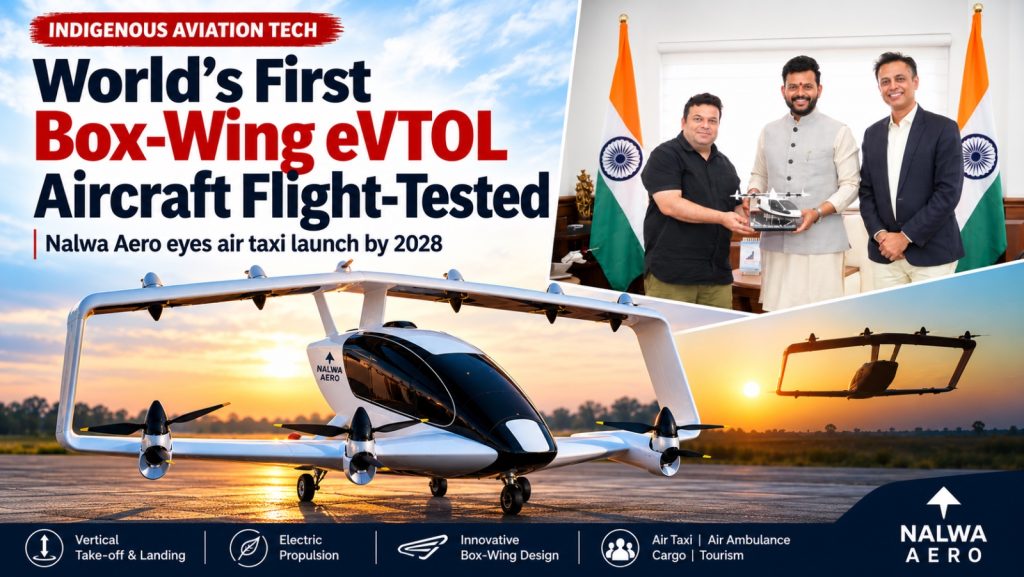
Nalwa Aero has successfully flight-tested a scaled model of its box-wing electric vertical take-off and landing (eVTOL) aircraft in Chandigarh, demonstrating hovering and forward flight. According to the company, this is the first flight test at this scale to combine a box-wing configuration, electric propulsion and fully tilting-rotor technology.

Unlike conventional aircraft, which have wings extending from either side of the fuselage, a box-wing design connects wing structures to form an enclosed shape. The configuration is intended to improve airflow and reduce aerodynamic drag. The concept was explored by aviation researchers, including German scientist Ludwig Prandtl, more than a century ago.
Preliminary internal studies by the company indicate that the design could improve certain aerodynamic efficiency parameters by up to 40% compared with selected conventional aircraft configurations. This remains an early estimate and does not establish an equivalent reduction in overall energy consumption.
The aircraft features rotors that pivot during flight. During vertical take-off these rotors will be angled to provide downward thrust. As the aircraft moves forward the rotors will tilt allowing the eVTOL to fly vertically while also moving forwards without the need for traditional runways.
Kuljeet Singh Sandhu, Founder and CEO, Nalwa Aeros, says, “The idea is to make a new aircraft with an unconventional aerodynamic design. We want to get a proven scientific concept closer to real world aviation.”