

An analysis at Cornell University shows that the direction of an electric field affects heat conduction in aluminum nitride. The effect is evident from experiments conducted on boron nitride, which show that there is variation in thermal resistance when subjected to electrical stress.
The electric field can be a solution to thermal control in powerful semiconductor devices. Researchers at Cornell University have discovered that the direction of an electric field can affect heat conduction in certain materials.

This study was performed on aluminum nitride (AlN), a material characterized by an ultrawide-bandgap, which makes it able to withstand higher electric fields compared to other materials. This material can be used in high-voltage power and high-power radio-frequency electronics. But higher power densities also mean the generation of heat.
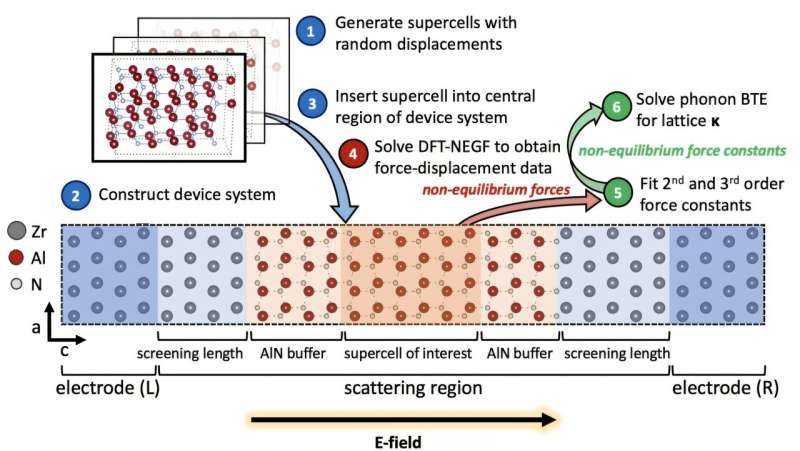
A team of researchers at Cornell University, led by Zhiting Tian, have developed a theoretical approach, which combines density functional theory (DFT) with the nonequilibrium Green’s function (NEGF) approach, called DFT-NEGF. This approach was modified in order to calculate thermal conductivity caused by phonons in an electric field. They simulated the structure of AlN crystals between two electrodes.
Conduction of heat in crystalline structures occurs in part by way of vibration in atoms, known as phonons, which help transfer thermal energy across the crystal lattice. Interaction among phonons causes scattering effects, preventing heat conduction. It was found that in presence of electric fields, the electron distribution is altered, altering the forces existing between atoms, and depending upon the orientation of the electric field with respect to the polarity of the crystal, atomic bonds could be weakened or strengthened.

In absence of any electric field, the thermal conductivity of aluminum nitride (AlN) film perpendicular to the film was predicted to be 334 watts per meter-kelvin, whereas applying an electric field in a certain direction increases this number while reversing the electric field decreases it.
In the complementary study, the material studied was hexagonal boron nitride (hBN), which is a material that has very wide bandgap characteristics and acts as an electrical insulator. A study was conducted on strong electrical fields exerted on single crystal hBN flakes with electrodes of metals using laser based frequency domain thermoreflectance to determine thermal resistances. In one particular device, the thermal resistances decreased up to 25% in repeated experiments. The results show that semiconductors can be designed in such a way that they will have to consider the direction of electric fields in order to control heat. If the crystals in a material are oriented in the direction of the electric fields in operation, heat transfer would be enhanced in high power electronic devices.