

The project uses LEGO bricks for its frame and motion system, alongside conventional electronics and a modified extruder.
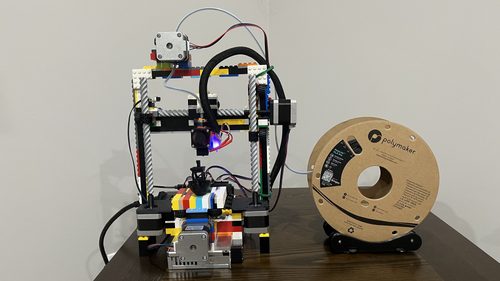
Most 3D printers use metal frames and standard mechanical parts. StudPrint takes a different approach, using LEGO bricks for much of its structure and motion system. Designed by maker Adam Turaj, the printer has demonstrated that it can produce a Benchy test model in about 75 minutes.

This project was built for Infill that was one of the Hack Club projects, where the objective was to build a 3D printer under $350 and with a custom design. The creator of the model used LEGO bricks for the body, mechanism, and some parts of the extruder. The creator claims that approximately 92 per cent of the printer is made out of LEGO parts, counting according to the number of pieces and not their weight.
The hardware includes a BigTreeTech SKR Pico V1.0 control board, a Mean Well LRS-150-24 24V power supply, a Raspberry Pi Zero 2 W and five NEMA 17 stepper motors. Four stepper motors drive the printer’s axes, while the fifth operates the extruder, which feeds filament to the hotend. There is a BLTouch bed leveling probe and the printer works with Klipper firmware.
StudPrint follows a bedslinger design, where the print bed moves back and forth beneath the nozzle. Its LEGO construction includes red 2×4 and 2×6 bricks, 15 LEGO wheels and 11 Technic worm gears. Conventional hardware is also used where needed, particularly for the electronics and parts of the motion system.

A little experimentation was required in order to make the extruder work correctly. In the first version, the extrusion force was provided by the wheels of LEGO; however, there was not enough grip to provide sufficient resistance against the friction of the Bowden tube and hot end. The wheels were replaced by Turaj with two gears and spring-tensioning system. Later he turned the extruder by 90 degrees to have a straighter track for the filament.
The repository for the project consists of CAD models, build logs, and a list of parts. The hardware design files are released under the CERN Open Hardware Licence version 2 – Strongly Reciprocal (CERN-OHL-S-2.0). The listed components, including an estimated US$60 allocation for LEGO parts, bring the estimated parts cost to US$196.82. These figures are given from the builder’s prices without taxes and delivery costs. The builder acknowledges that the prices may vary and the parts list is rarely updated.
The build journal records 59.25 hours of work on the project. At this point, the only print test performed has resulted in a Benchy printed in 75 minutes. The build does not state any build volume nor any other performance metrics regarding prints. The printer uses an unheated bed, which makes the types of filament usable on this printer limited.
The process of sourcing these parts for builders in India would require some planning on their part. Some parts in the bill of materials are related to suppliers from abroad, and the LEGO parts are listed according to the BrickLink numbering system. The local availability and import cost would impact the total cost of assembly. Makerspaces and college clubs that already have the required LEGO pieces and electronic components may find it easier to replicate the design.
For more information, click here.