

A Bluetooth wireless stereo reference design simplifies the development of true wireless earbuds and headphones with multiple operating modes and charging features.
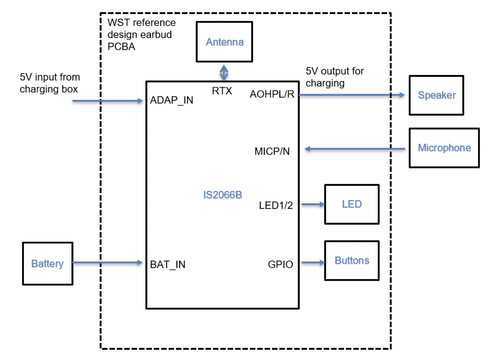
The Microchip IS2066B Wireless Stereo Technology Reference Design is intended for developing Bluetooth-enabled wireless stereo earbuds and headphones. The design supports the Advanced Audio Distribution Profile (A2DP) for stereo audio streaming, Advanced Audio Coding (AAC) audio, and phone calls through the Headset Profile (HSP) and Hands-Free Profile (HFP). It also supports simplified pairing and switching between the left and right earbuds. The design covers earbud operations such as automatic and manual power-on/off, reconnection between earbuds, microphone switching and single-earbud use.
The design provides hardware implementation details for developing Bluetooth Wireless Stereo Technology (WST)-based earbuds and headphones. It supports a simplified pairing process and optional automatic pairing with a device scanning for connections. It also includes link-loss management for situations where an earbud moves out of range or loses power. Its continuous talk mode allows users to use one earbud at a time, transfer an ongoing call from the active earbud to the idle one and extend continuous talk time. The design also provides an option to select the user interface tool.

The reference design offers three operating modes. In Auto Embedded Mode, the earbuds automatically power on and reconnect to each other when the charging case is opened and they are removed. When placed inside the case, the earbuds exchange information and begin charging. They turn off after charging is completed. This mode uses three manually operated buttons that can be configured for multiple functions, including power on/off, play/pause, answering or ending calls and microphone selection. Two additional buttons are provided for volume control and track navigation. The charging case must also provide 5V power at its charging ports when opened.
Manual Embedded Mode offers similar features, but the earbuds are switched on and off using buttons rather than automatically. Unlike Auto Embedded Mode, it does not require the additional charging case feature.

Host MCU Mode is intended for implementing functions that are not available in Auto or Manual Embedded Mode. These include advanced handover behaviour, Bluetooth Low Energy (BLE) communication with a mobile application or another device, and connections to external sensors.
The reference design includes a separate circuit for the charging case. It supports earbud detection through two charging ports, with two charging contacts for each earbud. The case can automatically power on an earbud when it detects that the earbud has been removed. It can also charge its internal battery through a Universal Serial Bus (USB) connection.
The charging case uses a power management solution that can detect a load current of 6–8mA and shut down the 5V output supplied to the Bluetooth audio chip. The design further specifies that the chip’s charge-complete delay-off time should be shorter than the charging case’s low-current detection off time to maintain correct in-and-out-of-case behaviour.
For PCB implementation, the design recommends using a four-layer or higher-layer board with a solid ground plane. The centre ground pad of the Bluetooth audio chip must be firmly connected to the inner ground plane using vias. The antenna should be kept away from large metal objects, and metal shielding around the PCB antenna should be avoided.
Microchip has tested this reference design. It comes with a bill of materials (BOM), schematics, an assembly drawing, a printed circuit board (PCB) layout and more. The company’s website has additional data about the reference design. To read more about this reference design, click here.