




How can security-critical systems protect sensitive data against physical attacks? An adaptive SoC combines backside protection with processing capabilities for demanding embedded applications.
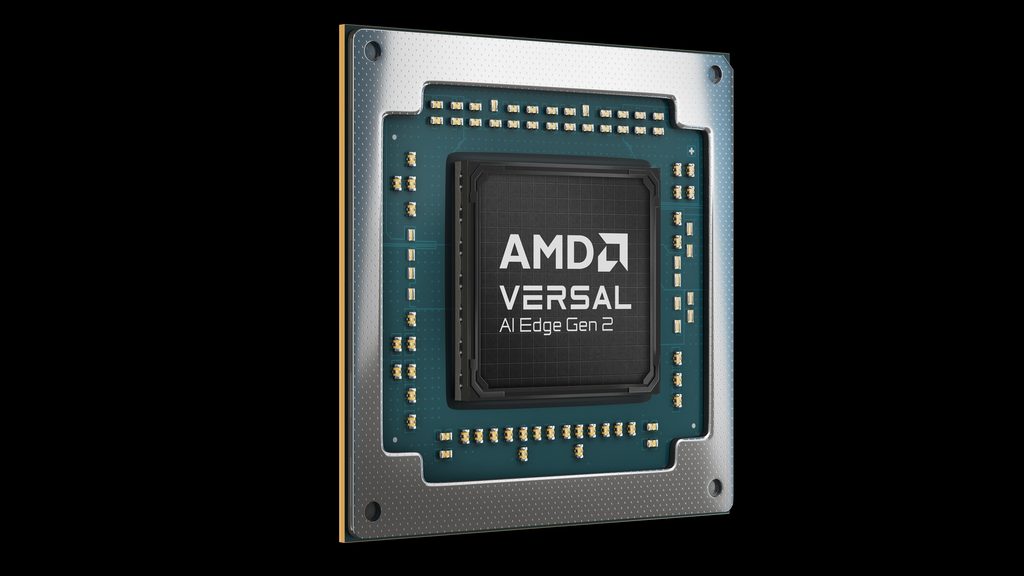
AMD has introduced its Versal tamper-resistant (TR) devices, designed to protect sensitive information against physical attacks in security-critical systems. Based on the Versal AI Edge Series Gen 2 architecture, the devices combine built-in physical attack protection with multiple computing capabilities, targeting applications in defence, data centre networking, fintech and critical industrial infrastructure.

The devices use a sensor-based protection die bonded to the main compute die through 3D active-on-active technology. This covers the silicon backside, detects physical attacks and prevents booting if the protection die is tampered with or removed. The approach is intended to reduce dependence on custom protection solutions involving separate components, mechanical enclosures and application-specific ICs (ASICs), helping simplify board design and save space.
The security features also include hardware acceleration for post-quantum cryptography, with support for ML-DSA and SLH-DSA algorithms. Additional safeguards include hybrid boot flows supporting multiple signature algorithms, an improved application security unit key vault and a memory element aging sensor. Enhanced glitch detection combines improvements to the existing architecture with an additional detector covering simultaneous glitches across two voltage rails.
For computing performance, the devices integrate Arm CPUs, AI Engines, programmable logic, hard IP and connectivity. They deliver up to 229,000 DMIPS of scalar computing performance, 369 INT8 TOPS and 543,000 lookup tables (LUTs).
The portfolio includes three devices, namely, 2VE3358TR, 2VE3558TR and 2VE3858TR. Footprint-compatible standard counterparts are available, allowing developers to transition to tamper-resistant versions without rerunning synthesis or place-and-route processes.
Kirk Saban, Corporate Vice President, Product, Software and Solutions, AMD Embedded, says that the devices combine physical attack protection with high-performance computing to simplify the development of security-critical systems.
The first devices are expected to enter sampling in the second half of 2027, followed by production in the first half of 2028.
Click here for the official announcement.
