The effort is a step towards enabling electronics DIY enthusiasts to fabricate their own semiconductor chips
Yes, you read the title correctly.
But the exorbitant expenses involved in procuring the required equipment is enough to deter anyone from developing homemade silicon chips. So why bother when you can purchase them at a fraction of the cost from the market?
Well, no doubt you do need some advanced equipment including a high-temperature oven, a powerful electron microscope, high-end software for scanning probe microscopy purposes, etc. But the fabrication process is quite fun and also teaches a thing or two about semiconductor ‘mechanics’.
So remember the saying “where there’s a will, there’s a way”. Silicon wafer fabrication can be achieved at your home – with a slight modification.
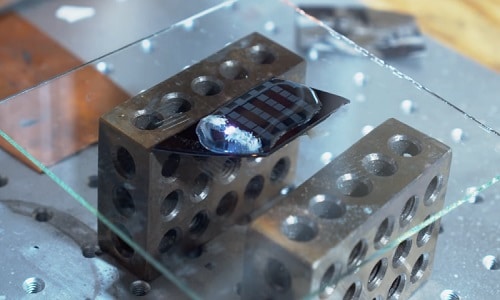
As demonstrated in a video by Zachary Tong on his YouTube channel Breaking Taps, he experimented with doping a silicon wafer with phosphoric acid and a fibre laser that’s near-infrared using a process called thermal diffusion.
In the absence of a furnace with very high temperatures, conducting the doping process with a laser acts as a suitable alternative to transfer the same amount of heat. Simply place the dopant upon the wafer and embed it using precise laser pulses.
However, do note that as opposed to infrared lasers, UV lasers are much preferred in doping scenarios and widely used in industries as they tend to have less optical penetration, thereby damaging less silicon wafer.
Although the outcome was mixed and not perfect as compared to factory manufactured silicon wafers, the effort paved a path for electronics DIY enthusiasts wishing to fabricate semiconductors on their own.
The concept of self-fabricating silicon chips sounds quite appealing. At first, the results might not be as ideal as you expect. But with a few trials and errors, you will eventually make progress and start building custom silicon chips in your backyard.