





Based on a cylindrical power coil, a uniform charging field gets transmitted while also fulfilling certain safety requirements
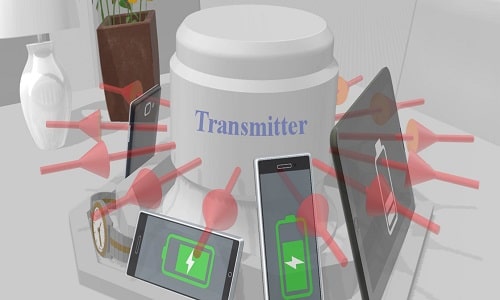
Although not a mainstay yet for power transfer, wireless chargers offer a unique and hassle-free way for charging portable electronic devices. No need for an electric outlet is required, which conventional wired chargers rely on.

But the main obstacle for creating a reliable wireless charger that is also omnidirectional is that power transfer occurs quite inefficiently owing to the fluctuating strength of the charging field in a location. Any orientation in the wrong spot wouldn’t lead to efficient results. This issue can be solved by using several transmitter coils connected to several power sources for creating a strong charging field. However, this approach increases the complexity of the transmitter. While feedback can properly orient the charging field, the control systems themselves are also complicated and expensive.
To solve this problem, researchers at Aalto University have recently developed an omnidirectional charging system that allows devices placed anywhere around it to get charged with uniform strength. The development addresses the challenge present in existing power transfer system around offering a convenient and reliable design for consumer use
The key to the new design is a cylindrical power coil. The wire at the top of the coil is wound in the opposite direction to the wire at the bottom of the coil, with a z-shaped bridge connecting them. Since the current flows through these windings in opposite directions, they produce complementary magnetic fields. One field flows out from the middle of the cylindrical coil, around the top winding, and back in through the top. The other flows out from the middle, around the bottom coil, and back in through the bottom.
This results in an even magnetic field around the middle of the charging coil. Receivers placed anywhere within that area charge efficiently, regardless of their position or orientation.
“This was just a proof of concept,” said Yining Liu, researcher and a doctoral candidate at Aalto University. “Now we can work to improve the efficiency – maybe to around 90% – and also the power.”
Based on simulations of the electromagnetic field around a consumer device, the researchers found that the level of exposure conformed to the requirements in safety regulations. However, further safety study is required for full usage.
The new design complements recent work from the same research group, which made it possible to transfer power to multiple, moving receivers in a charging area. The two technologies address different dimensions of the challenge of wireless charging: freedom of movement for industrial applications and free placement for consumer, tabletop devices.
Read here for more



