




Reference design provides a high-power-density four-phase buck converter with integrated gallium nitride switching for automotive power applications.
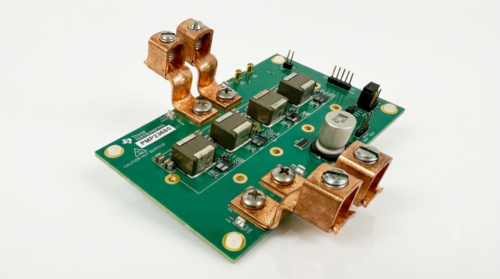
Texas Instruments has developed a 400 W four-phase buck converter reference design for automotive power systems. The design converts a nominal 48 V input into a regulated 5 V output and can deliver up to 80 A, with each phase supporting up to 20 A. It is intended for applications such as advanced driver-assistance system domain controllers, in-cabin monitoring electronic control units and zone control modules.
The DC-DC converter operates from an input-voltage range of 36 V to 60 V and provides a regulated 5 V output. The four-phase interleaved synchronous buck configuration distributes the output current among the phases, supporting high-current operation while maintaining a compact design. The reference design achieves an efficiency of 94 to 96 per cent across the specified input-voltage range.
The design uses four synchronous buck converters in a four-phase interleaved configuration, with gallium nitride switching devices enabling high-frequency operation. The converters also support dual-side cooling, providing additional flexibility for thermal management in compact automotive systems.
The reference design operates at a nominal switching frequency of 400 kHz and can deliver up to 80 A at the 5 V output. Test documentation provides information on the operating specifications, efficiency and output-voltage behaviour under various load conditions. For steady-state loads above 45 A, Texas Instruments recommends additional airflow over the board to manage thermal conditions.
Texas Instruments provides extensive design resources, including a test report, assembly drawings, bill of materials, CAD/CE files, Gerber files, PCB layout files and schematics. The fully assembled board is intended for testing and performance evaluation only and is not for sale. These resources help engineers evaluate the four-phase power architecture and adapt the design for automotive applications requiring high-current, high-density DC-DC conversion.
For more information, click here.

