Explore reference designs for humanoid robots covering motion control, AI, sensing, motor drives, and power systems.
Humanoid robots rely on precise, coordinated motion to walk, grasp objects, maintain balance, and interact with people. Achieving this requires efficient motor drives, accurate motion control, reliable sensing, and synchronised communication across multiple joints, while keeping size, weight, and power consumption under control. To simplify development, many companies now offer reference designs covering different aspects of humanoid motion control, from multi-axis motor controllers and joint electronics to complete robot development platforms and high-efficiency power stages.
Motor and motion control for humanoids

You can use NXP’s Motor and Motion Control for Humanoids and Mobile Robots reference design to build scalable motion-control systems for everything from individual robotic joints to complete humanoid robots. The platform enables precise torque, speed, and position control of BLDC and PMSM motors using field-oriented control (FOC), making it suitable for robotic arms and similar motion-control applications. You can integrate high-speed current sensing, industrial encoder interfaces, and multiple ADC channels for accurate motion and position feedback while using deterministic networking to synchronise multiple motor axes. The design also provides secure boot, device authentication, firmware updates, protected communication, and fault detection to improve system reliability and security.
Applications. The reference design is suitable for applications such as robotic arms, dexterous hands, and autonomous mobile systems that rely on precise motion control.
OEM Brand. NXP Semiconductor

See more details about the Motor and motion control for humanoids
Humanoid robot hand
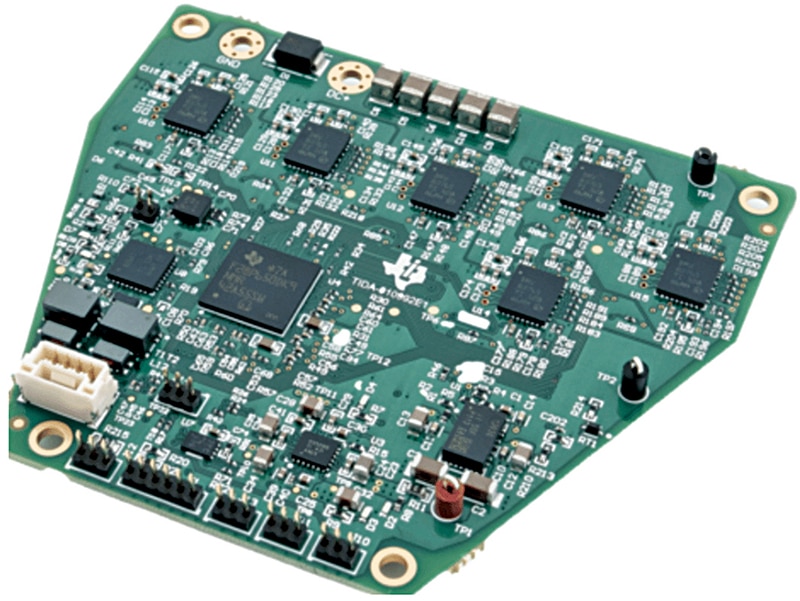
Humanoid robots rely on many small motors to control fingers and joints, making multi-axis motor control a major design challenge. Texas Instruments’ reference design helps address this by allowing a single controller to operate six independent brushless DC (BLDC) motors instead of using one controller for each motor, reducing board space, component count, and hardware complexity. Designed for compact robotic systems, it supports six-axis field-oriented control (FOC) with current, speed, and position control for coordinated movement in robotic fingers, grippers, dexterous hands, and similar applications. It supports 12V and 24V power supplies and motors up to 80W, allowing you to evaluate motor performance, optimise control algorithms, and test multi-axis motion before production.
The complete six-axis motor-control circuitry occupies less than 420mm² of board space, making it easier to fit electronics into space-constrained areas such as robotic fingers and palms while leaving room for sensors, batteries, and communication modules.
Applications. The reference design is suitable for applications such as robotic fingers, grippers, dexterous hands, and other systems that require coordinated movement across several joints.
OEM Brand. Texas Instruments (TI)
See more details about the Humanoid robot hand
Open humanoid robots