





Desktop Power Supply

Useful for electronics hobbyists, this linear workbench/ desktop power supply converts a high input voltage (12V) from the SMPS of a PC into low output voltage (1.25 to 9 volts). An adjustable three-pin voltage regulator chip LM317T (IC1) is used here to provide the required voltages. The LM317T regulator, in TO-220 pack, can handle current of up to 1 amp in practice.

Desktop power supply circuit

Fig. 1 shows the circuit of the desktop power supply. Regulator IC LM317T is arranged in its standard application. Diode D1 guards against polarity reversal and capacitor C1 is an additional buffer. The green LED (LED1) indicates the status of the power input. Diode D2 prevents the output voltage from rising above the input voltage when a capacitive or inductive load is connected at the output. Similarly, capacitor C3 suppresses any residual ripple.
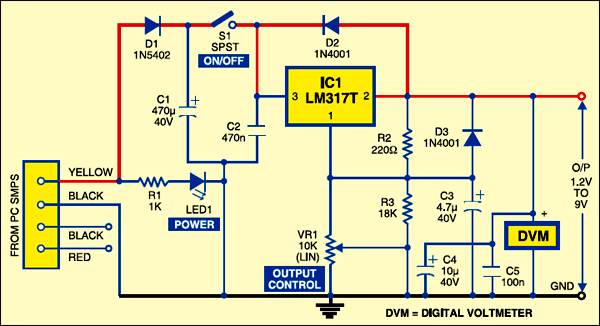
Fig.1: Circuit of desktop power supply

Connect a standard digital voltmeter in parallel with the output leads to accurately set the desired voltage with the help of variable resistor VR1. You can also use your digital multimeter if the digital voltmeter is not available. Switch on S1 and set the required voltage through preset VR1 and read it on the digital voltmeter. Now the power supply is ready for use.
- Advertisement -

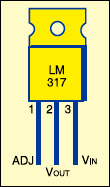
Fig.2:Pin Configuration of LM317

Construction & testing

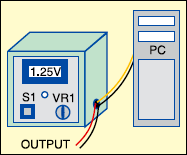
The circuit can be wired on a common PCB. Refer Fig. 2 for pin configuration of LM317 before soldering it on the PCB. After fabrication, enclose the circuit in a metallic cover as shown in Fig. 3. Then open the cabinet of your PC and connect the input line of the gadget to a free (hanging) four pin drive power connector of the SMPS carefully.
- Advertisement -

Fig.3: Sugested power supply box


The article was first published in September 2007 and has recently been updated.

T.K. Hareendran, Electronic Design Freelancer, AspenCore
T. K. Hareendran is a veteran electronics expert, educator, and technology writer with over 30 years of hands-on experience in the field of electronics and embedded systems. His journey began with a deep curiosity about how technology works, which evolved into a lifelong passion for understanding and building electronic systems. Over the decades, Hareendran has witnessed and actively engaged with the evolution of electronics—from early circuit designs and discrete components to modern microcontrollers, embedded platforms, and advanced digital systems. His expertise spans circuit design, hardware development, and practical electronics, backed by extensive real-world experience. Known for his ability to simplify complex concepts, he has dedicated many years to knowledge sharing, helping students, hobbyists, and professionals navigate the intricacies of electronics. His writing focuses on making technical subjects accessible, combining clarity with practical insights that readers can apply in real-world scenarios. Hareendran continues to contribute to the electronics community through educational content and hands-on guidance, driven by a strong belief in the power of curiosity, continuous learning, and shared knowledge.

SHARE YOUR THOUGHTS & COMMENTS

EFY Prime

Unique DIY Projects

Truly Innovative Electronics

Electronics News

Latest DIY Videos

Electronics Components

Electronics Jobs

Calculators For Electronics