




A way to build automotive climate systems is here—combining motor control, sensing, and user interfaces to reduce development time and support new system capabilities.
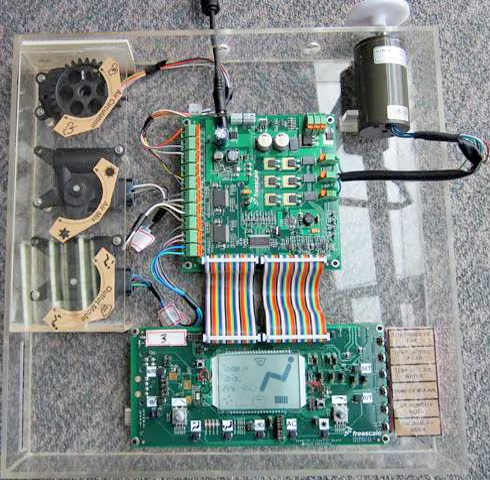
The automotive heating, ventilation, and air conditioning (HVAC) systems have evolved into integrated mechatronic platforms that demand motor control, sensor fusion, and climate management. The NXP Semiconductors S12G-based HVAC reference platform provides engineers with a framework for developing automotive climate control systems by combining control, power electronics, and human-machine interface (HMI) functionality.
At the center of the platform is an automotive-grade microcontroller designed for operation, power consumption, and real-time performance. The control architecture supports motor technologies used in HVAC applications, including stepper motors for air flap positioning, brushed DC motors for actuator movement, and sensorless brushless DC motors for blower operation. This multi-motor capability is useful for engineers designing climate zones, air-distribution mechanisms, and blower systems.
From a system design perspective, the platform is organized into two functional blocks: a control board and a motor control board. The control board is responsible for system management, user input processing, and sensor data acquisition, while the motor control board handles power-stage operation and motor-driving functions. This architecture provides flexibility for customization and simplifies hardware debugging and system scalability. It also enables adaptation across vehicle platforms and HVAC configurations.
One of the strengths of the platform is its sensing capability. Environmental sensors—including temperature, humidity, ambient light, and air-quality sensors—provide feedback about cabin conditions. For control engineers, this creates opportunities to implement climate control strategies such as thermal feedback loops, airflow management, and air recirculation control. By using sensor-driven algorithms, HVAC systems can optimize cabin comfort while reducing energy consumption.
The human-machine interface is another element of the design. The system can support an LCD display to provide users with information such as temperature settings, blower speed, operating modes, and system status. Input methods, such as rotary controls, touch keys, or touchscreen interfaces, can be integrated to support user interaction. Offloading display and interface functions to control resources helps preserve timing for motor-control and climate-regulation tasks.
From a software perspective, the platform includes an automatic climate control framework that can be adapted to application requirements. Engineers can customize climate control algorithms based on vehicle size, cabin layout, and thermal response characteristics. Features such as temperature regulation, blower-speed adaptation, and air-distribution control can be implemented and tuned for use cases.
For design engineers, the advantage of an HVAC reference platform is reduced development time and lower design risk. By starting with a validated hardware and software architecture, engineering teams can focus on product differentiation rather than system integration. Customization options such as motor type, actuator count, display configuration, and user-interface extensions make the platform suitable for automotive applications. This approach accelerates prototyping, shortens time-to-market, and provides a foundation for automotive climate control systems. To read more about this reference design, click here.

