

A nanoscale quantum device converts electrical current into controlled sound-like vibrations, opening pathways for phonon-based electronics, ultra-fast communication systems, and next-generation sensing and medical technologies.
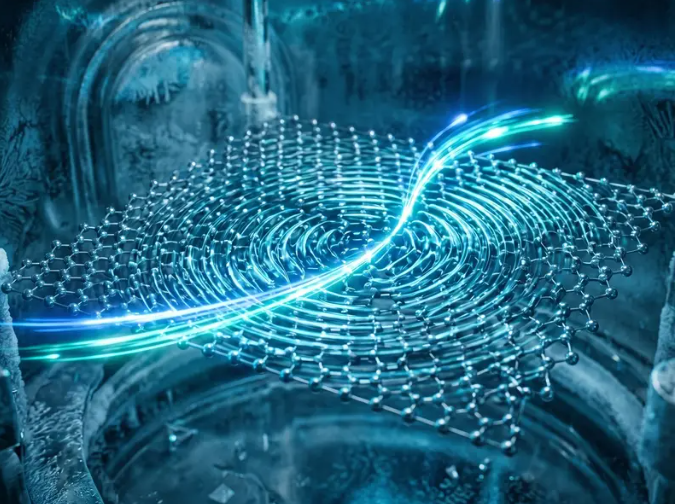
The research on the nanoscale quantum device that converts electricity into sound was led by scientists at McGill University in Montreal, with Michael Hilke serving as a key researcher and co-author, alongside a broader team of physicists including contributors such as Z. T. Wang; the work also involved collaboration with the National Research Council of Canada for device development and analysis, while materials used in the experiment were synthesized at Princeton University.
Researchers have developed a nanoscale quantum electronic device that converts electrical current directly into sound-like vibrations, marking a significant advance in quantum electronics and signal processing. The breakthrough could enable a new class of phonon-based devices, including ultra-precise sensors and next-generation communication systems.
The device operates by driving electrons through an ultra-thin, two-dimensional crystal channel under extremely low temperatures. As the electrons accelerate, they release energy in the form of quantized sound waves known as phonons rather than heat or light. These phonons can be generated in controlled, tunable bursts, making the system highly adaptable for electronic and quantum applications.
Unlike conventional electronics that rely on photons or electrical signals, this approach leverages phonons as information carriers. This is particularly useful in environments where electromagnetic waves are less effective, such as underwater communication or within biological systems, where sound propagation is more efficient.
The technology is built on nanoscale engineering principles similar to Nanoelectromechanical systems, where electrical and mechanical functions merge at atomic dimensions. At these scales, quantum effects dominate, enabling new forms of energy conversion and signal control that are not possible in traditional semiconductor devices.
A key finding is that electrons can emit phonons when pushed beyond the material’s “sound barrier,” a regime previously unexplored in such systems. This challenges existing theories of electron behavior and suggests new physics governing energy transfer at the quantum level. Looking ahead, researchers believe the device could lead to the development of “phonon lasers” systems that generate coherent sound waves analogous to optical lasers. Potential applications span high-speed data transmission, advanced medical imaging, and precision sensing technologies.
While still at an early research stage, the innovation highlights a broader shift toward hybrid quantum devices that convert energy across different physical domains. As nanoscale electronics continue to evolve, such cross-domain transduction could play a critical role in future computing and communication architectures.