It combines microcontroller, analog, sensing, data-conversion, and power functions to help engineers rapidly prototype and validate embedded-system architectures.
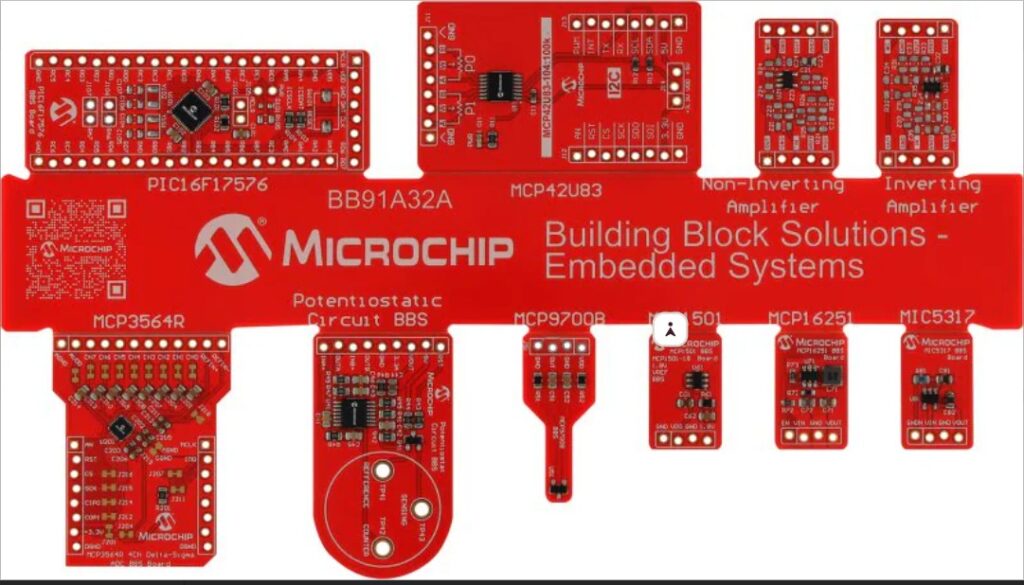
Microchip Technology’s Building Block Solutions Embedded Systems Reference Design provides design engineers with a modular hardware platform for evaluating, combining, and adapting key analog, mixed-signal, power, sensing, and microcontroller functions in embedded-system development. The BB91A32A kit is structured around individual Building Block Solution (BBS) boards, allowing engineers to evaluate circuit functions independently before integrating them into a larger system. This modular approach can reduce the time spent developing basic circuit sections from scratch and provide a practical starting point for proof-of-concept development, subsystem evaluation, and customized embedded designs.
At the core of the reference design is the PIC16F17576 8-bit microcontroller, which is supported by a collection of peripheral circuit blocks. The kit includes the MCP3564R, an eight-channel, low-noise 24-bit delta-sigma ADC, providing a high-resolution interface for converting sensor and analog signals into digital data. For applications requiring adjustable analog parameters, the MCP42U83 dual-channel digital potentiometer provides digitally controlled resistance through SPI or I2C interfaces. The design also includes separate inverting and non-inverting amplifier blocks, enabling engineers to evaluate signal-conditioning stages without first developing the complete analog front end.
The platform also addresses measurement and sensor-interface requirements through a potentiostatic circuit block and the MCP9700B low-power linear active thermistor IC. These blocks can be useful when developing temperature-monitoring, sensing, instrumentation, and other analog measurement functions. For power-management sections, the MCP16251 synchronous boost converter provides a low-quiescent-current voltage-conversion option, while the MIC5317 150 mA low-dropout regulator can be used where a compact regulated supply rail is required. The MCP1501 high-precision buffered voltage reference provides a stable reference source for precision analog and data-conversion circuits.
For design engineers, the key advantage is the ability to treat these circuits as reusable functional building blocks rather than isolated components. Engineers can evaluate individual blocks, combine several boards to reproduce a system-level signal chain, and then use the resulting architecture as a basis for a custom PCB. The reference design provides supporting resources, including schematics, bill of materials, Gerber files, assembly information, and 3D documentation, which can assist with circuit verification and PCB implementation.
The modular architecture is particularly useful for embedded applications that combine sensing, signal conditioning, analog-to-digital conversion, processing, voltage regulation, and power conversion. It can support early-stage prototyping as well as subsystem development, allowing engineers to validate circuit concepts before committing to a complete production design. By providing tested functional sections and corresponding design documentation, the Building Block Solutions platform can help shorten development cycles, simplify circuit experimentation, and provide a practical route from individual component evaluation to integrated embedded-system design.
Microchip has tested this reference design. It comes with a bill of materials (BOM), schematics, assembly drawing, printed circuit board (PCB) layout, and more. The company’s website has additional data about the reference design. To read more about this reference design, click here.