




RapidRadio’s innovation is not another RFID reader but a complete electronics platform that enables manufacturers to develop their own solutions faster and with greater flexibility. The result is a homegrown technology now deployed in more than 500 libraries and numerous industrial applications.
Every time a FASTag lane opens automatically, or an EV charging station recognises a user, or a vehicle enters a gated community without stopping, an RFID reader works silently in the background. Although such systems are now part of everyday life, the electronics that power them are often imported from China, Europe, or the United States. Ahmedabad-based RapidRadio has spent nearly two decades reducing this dependence by developing indigenous RFID electronics platforms.
Founded by engineers Dhaval H. Kotecha, Nirav Karia, and Dushyant Upadhyay, RapidRadio focuses on developing core electronic architectures that enable manufacturers to build RFID-based products without relying on imported hardware. The company was established in 2006 within Nirma University’s incubation ecosystem, when RFID technology was still relatively unfamiliar in India.
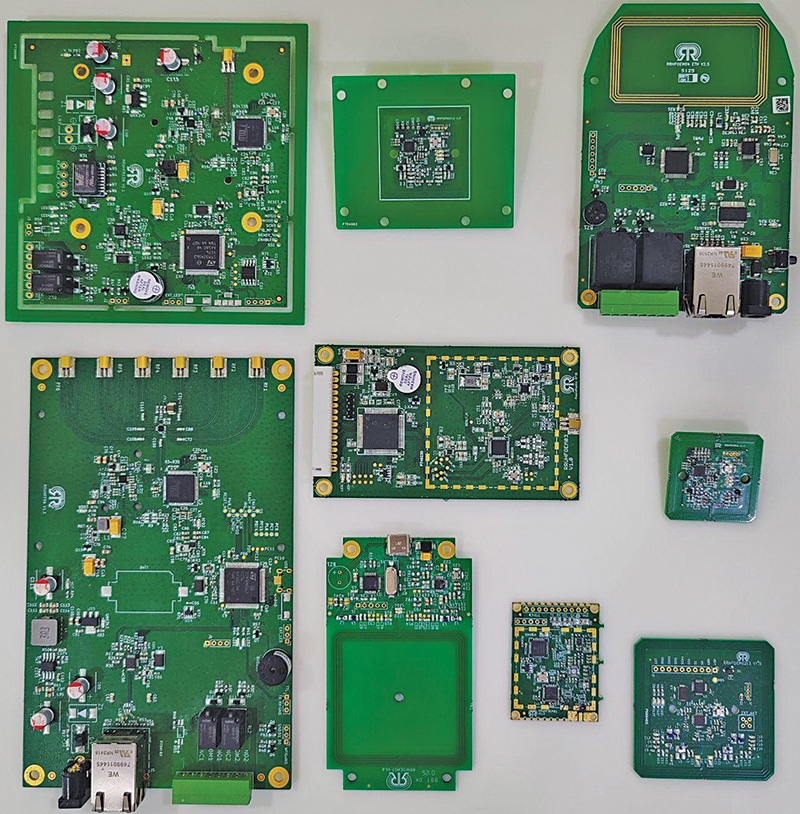
RapidRadio’s key innovation is its integrated ultra-high frequency (UHF) RFID module. This module combines RFID reading capability, embedded processing, communication interfaces, memory management, and control functions into a single platform. Instead of spending months integrating multiple electronic subsystems, manufacturers can use the module as a ready-made foundation and focus on their end applications. The technology supports smart parking systems, vehicle-access solutions, EV charging stations, industrial tracking platforms, and other RFID-enabled products while significantly reducing development complexity and time-to-market.
Developing such a platform was challenging. The founders first had to master antenna design. Although chip manufacturers supplied technical documentation for reader electronics, practical expertise in antenna tuning was limited. The team’s efforts resulted in a functioning RFID reader-and-antenna combination within about seven months, an achievement that often requires much larger organisations and longer timelines.
The next challenge emerged when the technology was exposed to real-world conditions. RFID systems frequently struggle in environments containing metal structures because metallic surfaces distort radio-frequency signals and reduce reading accuracy. RapidRadio adopted a different strategy by optimising reader-and-antenna combinations directly in deployment environments rather than under ideal testing conditions. This enabled reliable performance in factories, warehouses, industrial facilities, and other challenging locations where conventional RFID systems often underperform.
These experiences led to RapidRadio’s flagship product: a highly integrated UHF RFID module. RapidRadio’s platform serves as a complete electronics building block. A key differentiator is its flexibility. Because the technology is designed and controlled locally, customers can request modifications to hardware form factors, firmware features, communication interfaces, or application-specific requirements. Such customisation is often difficult to obtain from overseas suppliers, particularly for moderate production volumes.
This approach has helped RapidRadio evolve from a niche technology developer into a supplier serving multiple industries. Its RFID solutions are deployed in more than 500 libraries across India, reducing book issue and return times from nearly 20 seconds to less than five seconds. The company’s technology is also used in pathology equipment, EV battery-swapping infrastructure, vehicle-access systems, parking automation platforms, industrial asset-tracking solutions, and retail applications. A notable deployment is with Transasia Biomedical, where RFID readers authenticate consumables used in diagnostic machines. RapidRadio also supplies technology to customers and partners associated with Tata Group companies, Godrej, Sun Mobility, and numerous RFID system integrators across India.
Unlike many electronics start-ups that outsource most engineering activities, RapidRadio has retained its core design capabilities in-house. Manufacturing is outsourced to electronics manufacturing services (EMS) partners, while programming, calibration, and final quality checks remain under the company’s direct supervision. This model enables RapidRadio to concentrate on innovation while continuing to leverage scalable manufacturing capacity.
The company has steadily converted technological expertise into commercial growth. It currently employs about 55 people and reported a provisional turnover of ₹142.5 million in the last financial year, during which it shipped approximately 11,000 RFID readers. Importantly, this growth has been driven largely by customer revenues. An early investment from Gujarat Venture Finance Limited in 2007 was fully repaid by 2013, and the company has continued to expand without relying on continuous external funding.
Looking ahead, RapidRadio is applying the same philosophy to contactless payments. It is developing indigenous payment modules that support RuPay and other payment ecosystems, allowing manufacturers to build point-of-sale terminals, EV charging payment systems, transit-ticketing infrastructure, ATM solutions, and other payment devices using locally developed electronics.
At a time when Make in India discussions often emphasise local assembly, RapidRadio represents a deeper level of technological self-reliance. By creating foundational hardware platforms that other manufacturers can build on, RapidRadio is reducing dependence on imported technology.
