





As AI data centres scale, how can optical connectivity overcome the limits of electronic interconnects? In an interview, Rohin Y of LightSpeed Photonics speaks to EFY’s Saba Aafreen about reducing latency, improving manufacturability, and building India’s capabilities in advanced photonics packaging.
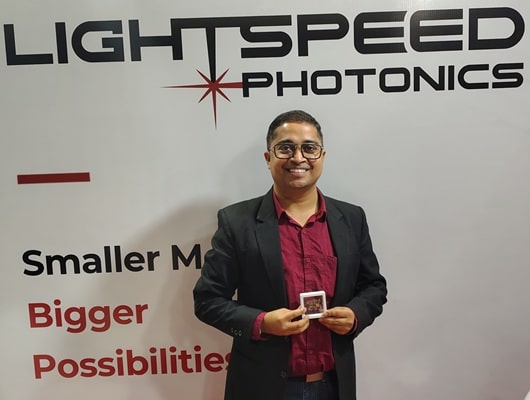
Q. What is LightSpeed Photonics showcasing at SEMICON India, and how does its technology address AI interconnect bottlenecks?
A. I am Rohin, the Founder and CEO of LightSpeed Photonics. We started with a vision to address interconnect bottlenecks in AI data centres. We recognised early on that the growth of AI would drive demand for high-performance computing (HPC) systems requiring enormous data-transfer bandwidth. About six years ago, we began developing ways to integrate high-bandwidth photonic interconnects directly into chips through co-packaged optics. We realised India lacked the facilities needed for advanced packaging and photonics integration. We saw this gap not merely as a resource constraint but as an opportunity to build indigenous capabilities. At SEMICON India, we are demonstrating the potential of indigenously developed technologies to address global interconnect challenges.
Q. Why are interconnects becoming a bottleneck in AI systems, and how can photonics help?
A. Data centres initially faced storage-related bottlenecks. As cloud computing and big data analytics grew, compute capacity became another constraint. Today, memory and interconnects are emerging as major bottlenecks. As AI systems grow in size and power consumption, their computing resources must be distributed across multiple systems to manage thermal and power requirements. Integrating these systems requires extremely high-bandwidth connections to transfer and process data efficiently. Copper interconnects face signal integrity challenges because they attenuate high-frequency signals over distance, limiting how far high-speed data can travel, even at the PCB level. Photonics addresses this by converting electrical signals into light, which experiences lower transmission loss and can carry high-bandwidth data over longer distances through optical fibres.
Q. What engineering challenges arise when bringing optical connectivity closer to chips, and how does your approach differ from pluggable optics?