




A single-motor robot uses wave-like body movements to swim through water and wheels to travel across rough terrain on land.
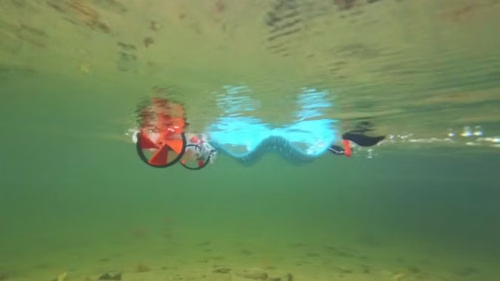
Researchers at Ben-Gurion University of the Negev have developed SAWbot, an amphibious robot. The robot can navigate through rough terrain on land and can also navigate in water using a continuous travelling wave to propel itself through the water.

SAWbot is inspired by anguilliform swimming, the method of locomotion used by eels and other elongated aquatic animals. Instead of using propellers or moving fins, it has a flexible, sheet-like body. A single motor creates a continuous wave-like movement along this flexible body. As the wave moves from one end of the robot to the other, it pushes against the water around it, which in turn propels the robot forward.
A motor turns a rotating member inside the robot. That rotation then pulls and pushes a membrane which is stretched between two supports. The membrane moves up and down in a continuous travelling wave. This travelling wave helps the robot move forward.
The robot’s front chassis contains the robot’s electronic components, control system and battery. These are protected inside a sealed box to prevent water from entering. Large wheels with deep grooves (treads) on both sides help the robot move across land. Two floats at the back help support the mechanism that generates waves and moves the robot through water. The robot can switch between moving on land and swimming in water without needing any mechanical changes or adjustments.
SAWbot has achieved speeds of up to 34 centimetres per second, with an advance ratio of 0.73 in swimming tests. The robot moved forward at 73% of the speed at which the wave it created travelled along its body. The researchers measured how much mechanical energy the robot needed to travel a certain distance. It could move across all these surfaces. Since its movement mechanism is relatively simple, researchers believe the design could be adapted to build larger or smaller versions in future.