Researchers developed an AI-driven materials engine that rapidly identifies new gallium semiconductor candidates, potentially reducing years of chip-material testing and accelerating innovation in future electronics, power devices, and optoelectronics.
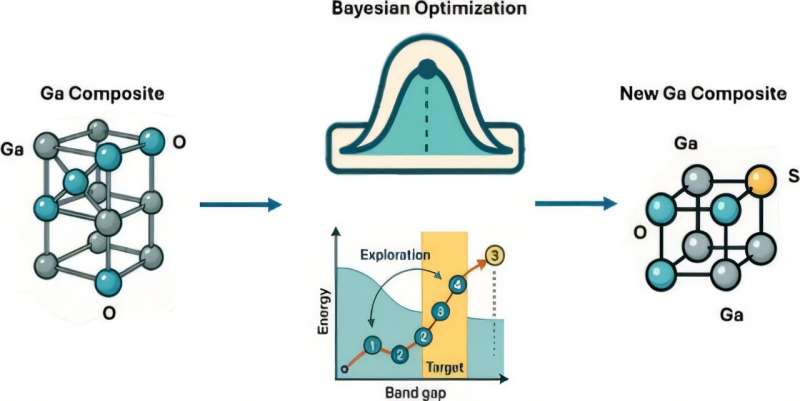
Artificial intelligence is moving beyond chip design and entering a new phase: discovering the materials that could power future generations of semiconductors. Researchers from Flinders University have developed an AI-based materials discovery system capable of rapidly identifying promising gallium-based semiconductor compounds, significantly reducing the time traditionally needed for experimentation and simulation.
The machine-learning framework was created by an international research team led by Flinders University in collaboration with Khalifa University. Instead of relying on slow trial-and-error testing, the platform acts as an intelligent materials-search engine that predicts new semiconductor candidates with specific electronic properties.
The development addresses a key challenge in semiconductor research: the enormous number of possible material combinations. Scientists often face millions of candidate structures, making laboratory testing and computational analysis expensive and time intensive. The new system narrows this search space by learning underlying chemical relationships and identifying realistic compounds with desired characteristics.
The AI model was trained using thousands of known semiconductor materials from global databases and employed Bayesian optimization techniques to continuously refine its predictions. Rather than generating random compositions, the system filters out chemically unrealistic or unstable combinations before proposing viable materials.
Researchers focused specifically on gallium-containing materials because of gallium’s increasing relevance in advanced electronics. Gallium compounds already support high-speed switching circuits, microwave electronics and infrared technologies, and are gaining greater attention for next-generation chip architectures.
One of the main targets of the search was semiconductor band-gap tuning, a property that determines how a material interacts with electricity and light. Different band gaps serve different electronic applications, ranging from solar energy harvesting and LEDs to high-power electronics and radiation-resistant systems.
The study generated multiple previously unknown gallium semiconductor candidates absent from existing databases, potentially shortening the route from theoretical material design to practical electronic implementation. For semiconductor developers, the advance may represent a shift from material discovery through exhaustive testing toward AI-guided prediction and validation.