




A SoC combines AI processing, graphics, and computing in one platform, enabling AI agents, content creation, software development, and gaming on PCs.
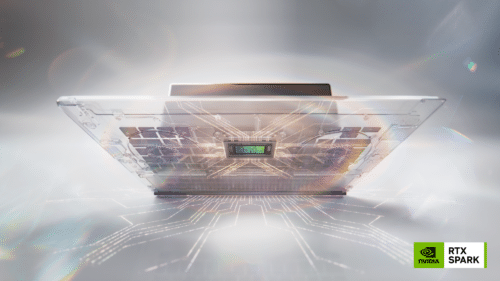
NVIDIA has launched RTX Spark, a new computing platform designed to bring AI agents, content creation tools, and gaming capabilities directly to Windows PCs.
The platform combines an NVIDIA Blackwell RTX GPU and a 20-core NVIDIA Grace CPU in a single RTX Spark superchip. Built for on-device AI processing, the system provides up to 1 petaflop of AI performance and up to 128GB of unified memory, allowing users to run AI agents locally instead of relying entirely on cloud services.
A key focus of RTX Spark is support for personal AI agents on Windows. NVIDIA is working with Microsoft to provide a secure environment for these agents through new Windows security features and NVIDIA OpenShell, a runtime designed to manage agent permissions, protect user data, and control how AI models access local and cloud resources.
The platform is intended to support applications that can automate tasks, work across multiple software programs, search local files, generate images and videos, and assist with coding. Developers of AI agent projects such as OpenClaw and Hermes Agent are adopting the platform for upcoming Windows applications.
RTX Spark is also aimed at creators and developers. The platform supports NVIDIA technologies including CUDA, RTX, DLSS, TensorRT, OptiX, Reflex, and G-SYNC. Users can work with large 3D scenes, edit high-resolution video, and run large language models locally on supported systems.
For gaming, RTX Spark supports ray tracing, DLSS, and Reflex technologies, enabling high-frame-rate gameplay on Windows devices.
NVIDIA also announced new RTX features for the platform. These include DLSS 4.5 Ray Reconstruction with a second-generation transformer model, planned for Blender 5.3 and selected games, as well as RTX Video with 4x Frame Generation for ComfyUI workflows.
The superchip integrates an NVIDIA Blackwell RTX GPU with 6,144 CUDA cores and fifth-generation Tensor Cores connected to a 20-core NVIDIA Grace CPU through NVLink-C2C technology. MediaTek collaborated with NVIDIA on the Arm-based CPU design and connectivity technologies used in the platform.
Click here for the original announcement

